
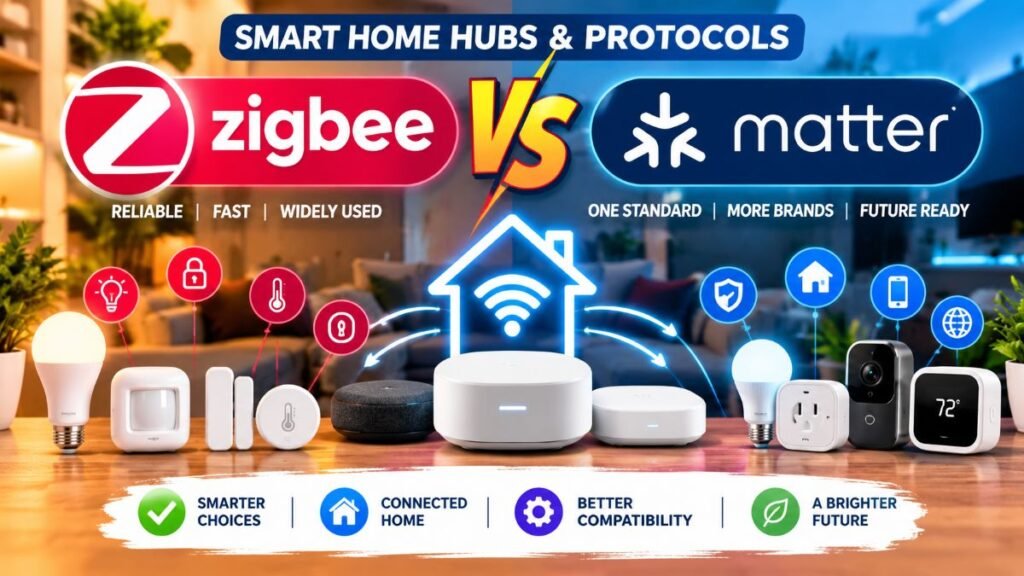
Buying a smart bulb only to realize it won’t talk to your lock or voice assistant is pure frustration. That exact connectivity nightmare is driving the Zigbee vs Matter battle in 2026.
Your choice determines whether your devices execute instantly offline or stall the moment your Wi-Fi flickers. Here is what actually separates these two protocols—and which one deserves a spot in your home setup.
Core Frameworks
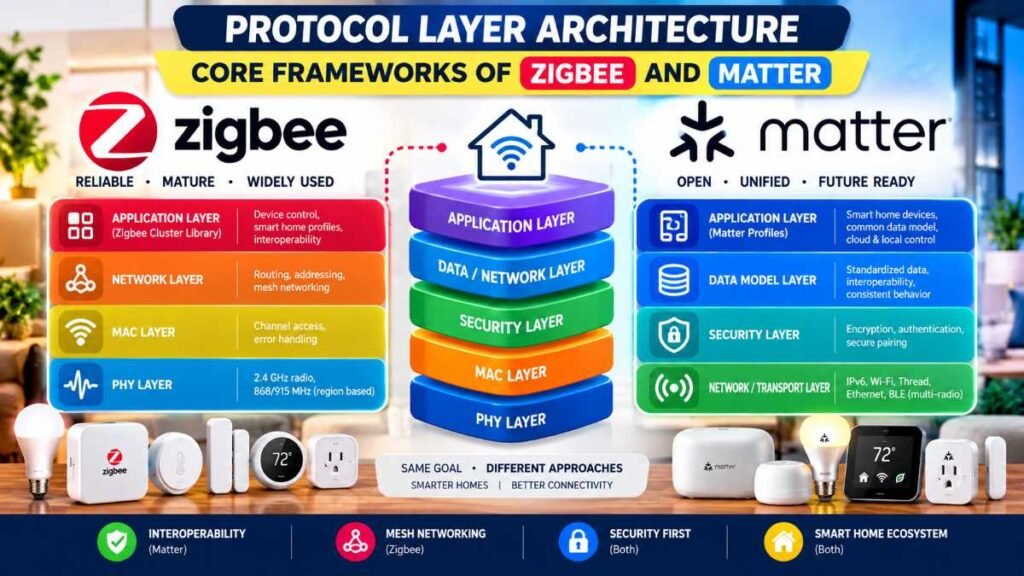
To make sense of Zigbee vs Matter, it helps to understand that they operate at different layers of smart home networking.
Layer Component | Zigbee Protocol Architecture | Matter Protocol Architecture |
Network Type | Low-Power IEEE 802.15.4 Wireless Mesh | Universal IPv6 Application Layer |
Transport Layer | Direct 2.4 GHz Radio Frequency | Wi-Fi, Ethernet, and Thread Mesh |
Primary Goal | Dedicated device-to-hub communication | Universal cross-platform interoperability |
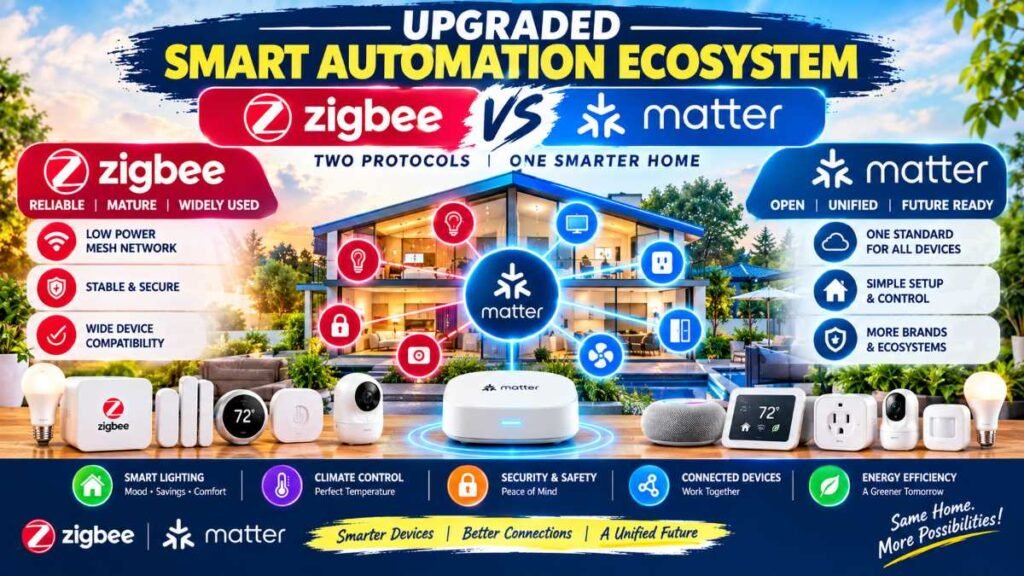
Zigbee is a low-power, short-range wireless mesh protocol (built on IEEE 802.15.4 standards). It communicates mainly over the standard 2.4 GHz wireless frequency. In a Zigbee network, every main-powered device (like a smart plug or switch) acts as a signal repeater, expanding coverage across your entire house without bogging down your home Wi-Fi network.
Matter is not a radio protocol itself; it is an open-source, unified application layer designed by the Connectivity Standards Alliance (CSA). Matter runs on top of existing network technologies like Wi-Fi, Ethernet, and Thread (a low-power mesh technology similar to Zigbee). Its mission is simple: universal interoperability across Apple Home, Google Home, Amazon Alexa, and Samsung SmartThings without relying on cloud servers. To see how hardware placement impacts local mesh reliability, explore our detailed guide on smart home installation.
Head-to-Head Comparison
Feature / Metric | Zigbee Architecture | Matter Protocol Standard |
Network Type | Dedicated Low-Power Wireless Mesh | Universal IPv6 Layer (Wi-Fi, Thread, Ethernet) |
Hub / Gateway Requirement | Requires a dedicated Zigbee hub/bridge | Requires a Matter Controller (e.g., Apple HomePod, Echo Hub) |
Interoperability | Ecosystem-dependent (requires bridges for cross-platform) | Native multi-admin capability across major platforms |
Local Execution & Speed | Sub-millisecond response times executed entirely through local RF mesh routing | Near-instantaneous local responsiveness leveraging direct IP packet transmission |
Device Selection & Maturity | Massive (10+ years of mature market devices) | Rapidly growing ecosystem across standard categories |
Bandwidth & Power Use | Ultra-low power; ideal for multi-year battery sensors | Low-power over Thread; high-bandwidth over Wi-Fi |
Interoperability & Ecosystems
The biggest friction point in smart home setups has always been platform lock-in.
When you evaluate Zigbee vs Matter, Matter’s “Multi-Admin” feature is a massive game-changer. Matter allows a single device to connect simultaneously to multiple smart home controllers. That means a single Matter-enabled smart plug can be controlled locally through your Apple Home app while your partner operates it via Amazon Alexa, without needing third-party skill integrations.
Platform / Ecosystem | Apple Home | Amazon Alexa | Google Home |
Matter Multi-Admin Direct Local IP | Native Direct Access | Native Direct Access | Native Direct Access |
Traditional Zigbee Route | Requires Bridge / Hub | Requires Specific Echo Hub | Requires Bridge / Hub |
Zigbee, while incredibly reliable locally, relies heavily on hub-specific profiles (like Zigbee Light Link or Home Automation). Connecting a Zigbee device to a non-native platform usually requires a central translator, such as a multi-protocol hub or customized platforms like Home Assistant.
If you are exploring broader setup options and looking to expand your overall property’s automation, reviewing practical guides on smart home automation can help you structure your hardware upgrades around your living space.
Range & Mesh Dynamics
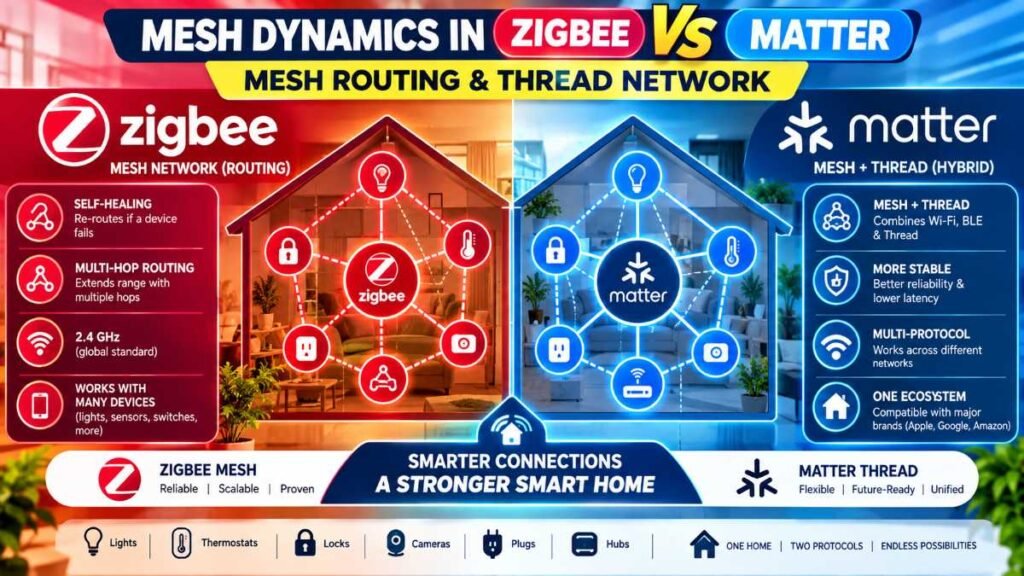
Both standards rely on mesh networking to eliminate dead zones in larger homes, but they handle network architecture differently:
Zigbee Mesh
In a standard Zigbee network, you have three device roles: Coordinators (the hub), Routers (mains-powered units), and End Devices (battery sensors). If your central hub drops offline, the entire Zigbee network loses its brain and ability to trigger complex automations.
Matter over Thread
When Matter utilizes Thread as its low-power transport layer, it forms a self-healing mesh with no single point of failure. Thread uses “Border Routers” (found inside modern smart speakers and displays) to connect the low-power mesh to your local Wi-Fi network. If one border router fails, another seamlessly takes over network management.
For homeowners interested in optimizing device placement and power usage across various rooms, taking time to review how mains-powered nodes act as mesh repeaters in our smart plug guide ensures your gear stays responsive while reducing standby power consumption.
Setup & Daily Management
Setting up smart home devices should not feel like configuring a corporate server. Here is how both protocols handle onboarding:
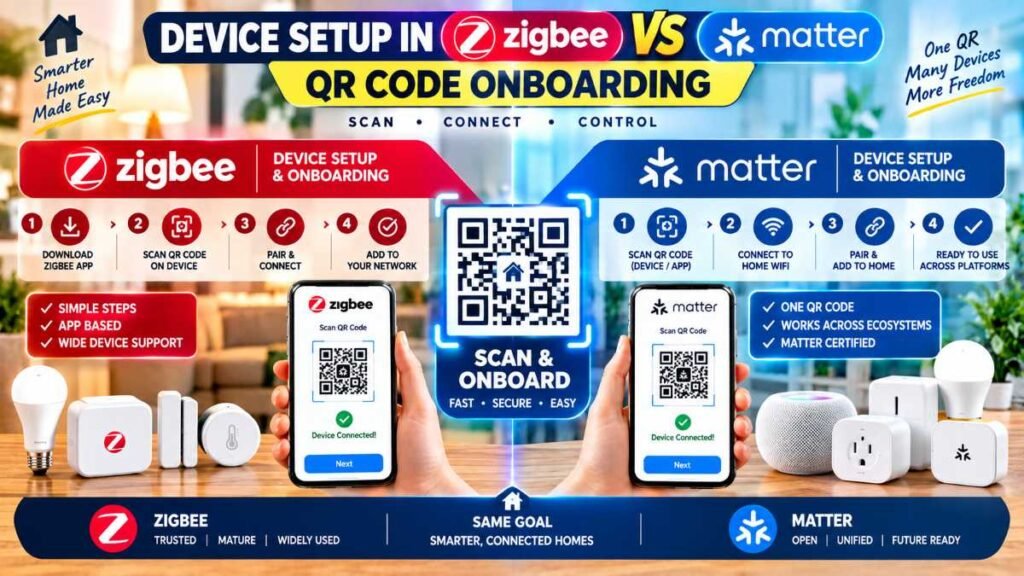
- Matter Onboarding: Matter uses standardized QR codes or NFC tags. You scan the code using your smartphone’s native home app, and the device pairs locally over Bluetooth Low Energy (BLE) before transferring to your Wi-Fi or Thread network.
- Zigbee Onboarding: Joining a Zigbee network requires setting your specific hub to “Pairing Mode” and pressing a physical button on the end device. While straightforward, pairing issues can arise if the device is located too far from the hub during initial setup.
Speed, Latency & Security
Both protocols prioritize local control, meaning your commands do not need to travel to a distant cloud server and back just to turn on a lamp.
- Latency: Commands sent over both Zigbee and local Matter networks execute almost instantaneously (typically under 100 milliseconds).
- Privacy & Security: Matter enforces mandatory AES-128 encryption and cryptographic device attestation backed by the Connectivity Standards Alliance. This ensures fake or compromised hardware cannot join your private home network. According to cybersecurity guidelines from the National Institute of Standards and Technology (NIST), cryptographic attestation and local verification prevent unauthorized IoT network access. Zigbee also employs AES-128 encryption, but implementation standards vary across manufacturers.
If you are currently evaluating hardware options to pair with your primary hub, browsing detailed hands-on reviews of the best smart locks provides extra clarity on device compatibility and security performance. To learn more about safeguarding network access, check our dedicated resource on smart home cybersecurity.
Strategic Decision Framework
When weighing Zigbee vs Matter, you do not necessarily have to pick a single winner today.
Current Smart Home Scenario | Recommended Protocol Strategy | Implementation Action |
Existing Zigbee Setup | Hybrid Integration | Keep current hub & add a Matter bridge/controller |
Greenfield Installation | Ecosystem-Agnostic Foundation | Opt for native Matter and Thread-enabled devices |
Choose Zigbee If:
- You already own a robust Zigbee hub (like Habitat, SmartThings, or a dedicated Home Assistant sky connect dongle).
- You want access to thousands of inexpensive, specialized sensors (contact, motion, water leak) that have been market-tested for years.
- You prefer keeping your smart devices completely isolated from your IP network.
Choose Matter If:
- You are starting a smart home from scratch and want native, hubless control across iOS and Android devices.
- You want cross-platform flexibility so family members can use different voice assistants seamlessly.
- You prefer future-proof hardware backed by tech industry leaders like Apple, Google, Amazon, and Samsung.
Coexistence & Bridges
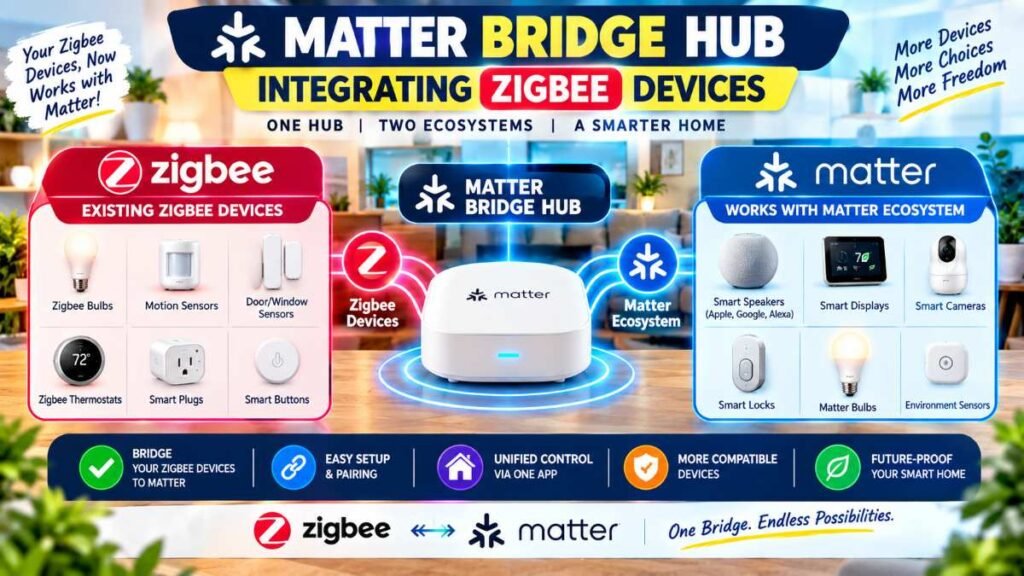
The reality of the Zigbee vs Matter landscape is that they will coexist peacefully for years to come. Major hardware manufacturers are not abandoning Zigbee; instead, they are updating their hubs to act as Matter bridges.
A Matter bridge translates your existing Zigbee devices into Matter-compliant endpoints. This means your reliable, legacy Zigbee door sensors can instantly show up in Apple Home or Google Home without needing hardware replacement. According to smart energy and device deployment research from the U.S. Department of Energy, maintaining local interoperability standards is vital for consumer IoT privacy and long-term energy efficiency.
Real-World Power Efficiency & Network Resilience
Building a multi-device setup requires balancing battery life, signal penetration, and continuous power draw across your living space.
- Battery Life & Efficiency: Standard Zigbee sensors excel at raw power management. Using lightweight radio frames, CR2032 coin-cell door and motion sensors routinely run 2 to 3 years on a single battery. Meanwhile, Matter over Thread sensors require slightly more keeping-alive signals over IPv6, averaging 18 to 24 months per charge.
- Wall Penetration & Signal Stability: A Zigbee vs Matter comparison reveals distinct mesh routing behaviors indoors. While Zigbee’s 2.4 GHz signal penetrates interior drywall easily, dense concrete walls can choke RF signals—requiring mains-powered plugs every 25 feet to extend range. Conversely, Matter over Thread uses dynamic Border Router failovers (like an Echo Hub or Apple TV) to instantly reroute commands if a physical barrier blocks a specific node.
Frequently Asked Questions
Q1. In the debate of Zigbee vs Matter, which protocol is faster?
Both offer instant local control under 100ms, but Matter over Thread eliminates single-point hub failures.
Q2. Can Zigbee devices work directly with a Matter smart home network?
Yes. Existing Zigbee devices easily connect to Matter using updated smart hubs that function as Matter bridges.
Q3. Do I need a central bridge or hub for Matter devices?
No dedicated proprietary bridge is needed, but a native Matter controller like an Apple HomePod or Echo Hub is required.
Q4. Does Zigbee vs Matter affect smart home device battery life?
Both protocols use low-power mesh architectures designed to keep wireless door sensors running for multiple years effortlessly.
Q5. Should I buy Zigbee or Matter devices for a new setup?
Opt for native Matter devices to ensure future-proof, multi-admin local compatibility across Apple, Google, and Alexa ecosystems.
Ready to Upgrade Your Smart Home?
Take control of your home network today! Evaluate your current devices, choose a unified Matter controller or multi-protocol bridge, and start building a fast, local automation ecosystem that works seamlessly for your whole family.
Editorial Disclaimer
This guide is created for informational and educational purposes. Smart home protocols and hardware standards evolve rapidly; always verify specific device specifications and hub compatibility before purchasing new equipment for your home network.
About the Author
Meet Dambar C. Rajbanshi
Dambar C. Rajbanshi researches smart home technology with a practical focus on compatibility, setup requirements, everyday usability, and long-term value. Every guide is written to help homeowners understand their options and make informed buying decisions.