
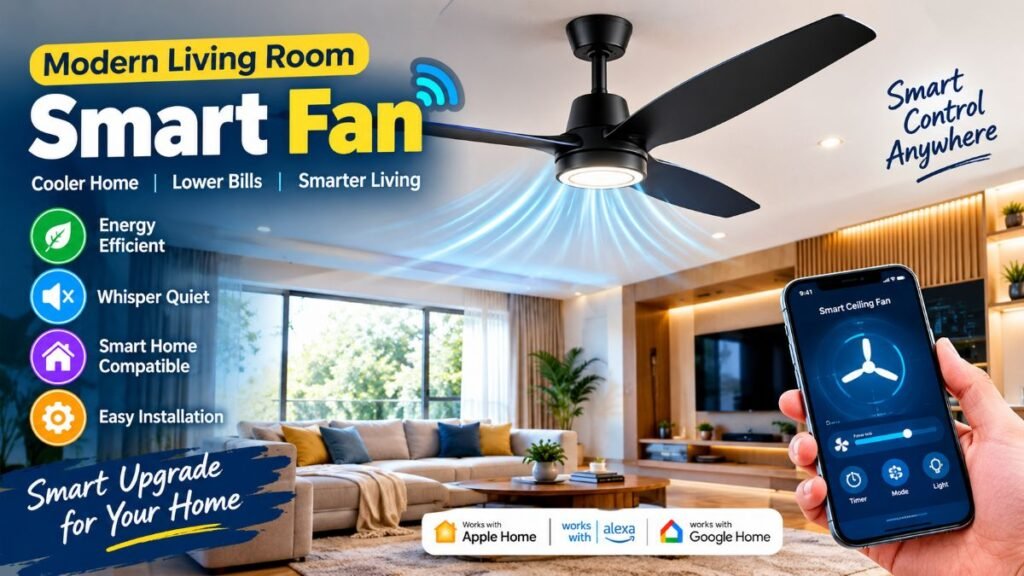
Imagine stepping into your living room on a sweltering July afternoon. Instead of hunting under sofa cushions for a missing remote or standing on tiptoes to yank a ceiling chain, your room instantly responds. The overhead blades quietly accelerate to a gentle, whisper-quiet breeze, syncing with your HVAC system to knock down humidity before you even kick off your shoes. Investing in a modern smart ceiling fan turns basic, clunky air circulation into an intelligent climate system that cuts cooling bills while effortlessly elevating daily comfort.
Executive Overview:
The leap from legacy AC pull-chain fixtures to connected Matter-over-Thread units represents a massive shift in residential energy management. Modern units swap power-hungry motors for whisper-quiet brushless electronics that execute commands instantly across local home networks.
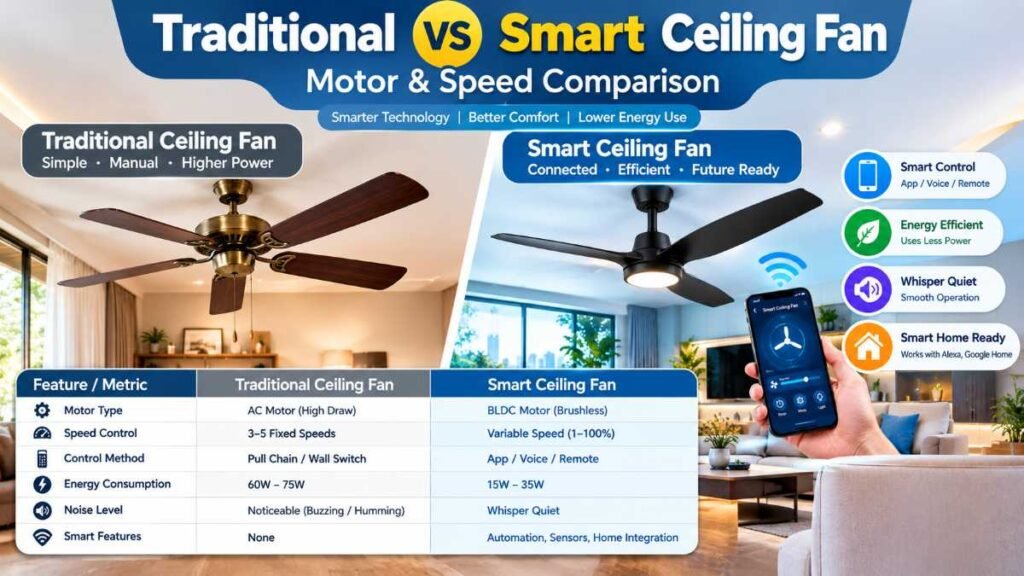
Feature / Metric | Traditional Ceiling Fan | Wi-Fi / App-Controlled Smart Fan | Native Matter-Over-Thread Smart Fan |
Motor Type | Standard AC Motor (High Draw) | Brushless DC (BLDC) Motor | Advanced Ultra-Low Draw BLDC Motor |
Command & Operation | Hardware Pull Switch / In-Wall Control | Proprietary App / Wireless Remote | Multi-Ecosystem Voice, Joint Household App & Edge Automation |
Ecosystem Support | None | Proprietary Cloud Skills / App | Native Apple Home, Amazon Alexa, Google Home |
Energy Consumption | 60W – 75W | 20W – 35W | 15W – 30W |
Command Response Time | Instant Mechanical Switch | Intermittent Web Latency (1–3s) | Near-Zero Local Hub Latency (< 100ms) |
Core Architecture
Unlike traditional fixtures dependent on line-voltage AC wall switches, high-efficiency smart fixtures utilize integrated microcontrollers paired with brushless Direct Current (BLDC) motors to regulate rotation dynamically.
| Environmental Detection Stage |
| (Indoor Climate & Relative Humidity Detectors) |
+————————————+
|
+————————————+
| Local Processing & Routing Stage |
| (Matter Border Router / Smart Hub) |
+————————————+
|
+————————————+
| Wireless Signal Reception Stage |
| (Low-Latency Thread Mesh / Wi-Fi) |
+————————————+
|
+————————————+
| Motor & Speed Regulation Stage |
| (Micro-Control Unit & Brushless Drive)
+————————————+
Key Hardware Components
- BLDC Motor Efficiency: Brushless DC motors run cooler than traditional AC induction motors, eliminate low-frequency humming noises, and typically consume significantly less power under average operating loads.
- Protocol Receivers: Built-in microcontrollers accept direct IP commands over Wi-Fi or low-power Thread mesh networks, bypassing single-point-of-failure cloud servers.
- Sensor-Driven Automation: When linked with room climate sensors, the smart ceiling fan dynamically alters its blade speed based on real-time ambient temperature spikes and indoor humidity.
Measurable Benefits
Swapping out outdated fixtures delivers practical financial and lifestyle rewards across every season.
+———————————+
| Year-Round Airflow Benefits |
+———————————+
|
+———————–+———————–+
| |
v v
+———————————+ +———————————+
| SUMMER MODE | | WINTER MODE |
| Counter-Clockwise Rotation | | Clockwise Low-Speed Rotation |
| Creates direct wind-chill | | Pushes trapped warm air down |
| Reduces felt temp by up to 4°F | | Redistributes ceiling heat |
+———————————+ +———————————+
Tangible Energy Savings
According to residential building efficiency data published by the U.S. Department of Energy (ENERGY STAR), proper air velocity from a ceiling fan creates a wind-chill effect that allows occupants to set their thermostat roughly 4 degrees Fahrenheit higher during summer without sacrificing personal comfort.
Whisper-Quiet Operation
Premium BLDC motors eliminate the deep hum common in legacy multi-speed capacitor setups. This acoustic drop makes them ideal for home offices, nurseries, and bedrooms.
Winter Heat Redistribution
Reversing blade rotation to a low-speed clockwise setting gently pushes warm air trapped at ceiling height back down into living spaces, helping lower heating requirements during cold snaps.
Ecosystem Interoperability & Local Control Realities
Selecting the right fixture requires understanding how it communicates with your central smart home architecture.
Protocol Layer | Compatible Controllers | Communication Channel | Primary Practical Advantage |
Universal Matter Layer | Apple Home, Amazon Alexa, Google Home, SmartThings | Local IP Mesh over Thread / Wi-Fi | Cross-platform control without relying solely on cloud connections |
Legacy RF / Proprietary Bridge | Brand-Specific Mobile Apps | Cloud API Routing / 433 MHz RF | Retrofit compatibility for legacy networks |
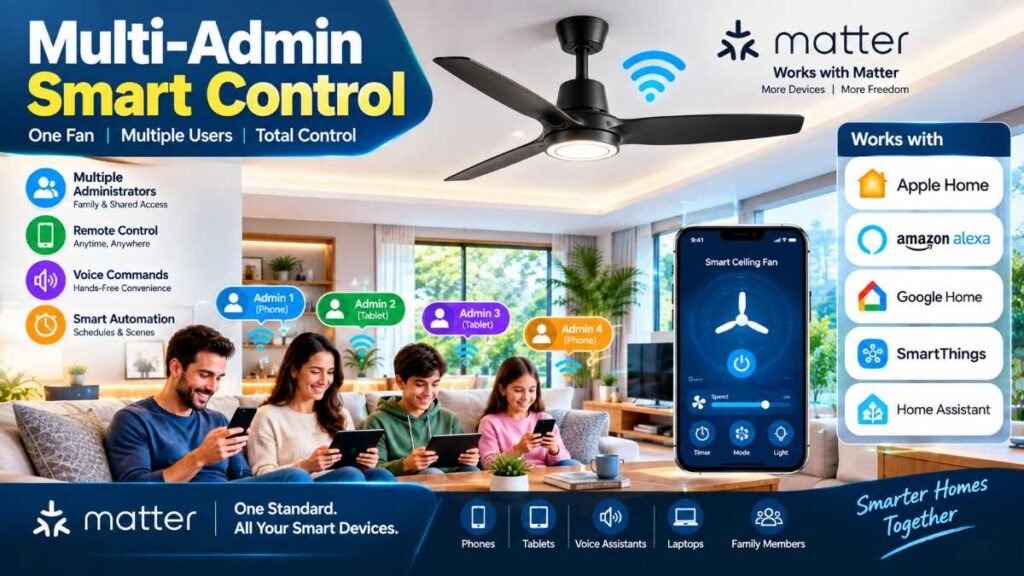
Modern units supporting Matter over Thread offer multi-admin capabilities, allowing housemates to manage fan speed and dimmable lighting through Apple Home, Amazon Alexa, or Google Home simultaneously.
Where supported, local Matter control reduces dependence on cloud-based commands and generally improves responsiveness. To coordinate power management across adjacent household fixtures, check out our smart plug guide.
Pre-Purchase Buyer Checklist
Evaluate room dimensions and electrical infrastructure before buying a new fixture:
+———————————————————————–+
| PRE-PURCHASE CHECKLIST |
+———————+——————-+—————————–+
| Blade Sweep | Outlet Enclosure | Airflow & Light Specs |
| Small: 36″-44″ | Fan-Rated UL Box | >150 CFM/Watt |
| Expansive: 60″+| Suspended Rod vs. Hugger Mount| CRI 90+ Tunable LED |
+———————+——————-+—————————–+
- Blade Sweep vs. Room Area: Bedrooms under 100 sq. ft. need 36–44 inch blades. Open spaces over 400 sq. ft. require 60-inch spans to circulate air effectively.
- Airflow Efficiency (CFM/Watt): Pick models delivering high Cubic Feet per Minute per watt for maximum air displacement with low energy draw.
- Ceiling Clearance & Outlet Box Requirements: If your ceiling is 8 feet high, go with a low-profile hugger design; use downrods for vaulted angles. Ensure the ceiling electrical box is certified to handle continuous motor vibration and weight.
- Tunable LED Lighting: Look for CRI 90+ arrays offering adjustable color spectrums (2700K–5000K) to match daily lighting preferences.
For box load verification and mounting safety, consult our smart home installation guide.
Linking Smart Fans with Climate
Linking your motorized airflow hardware into broad home automation routines enhances everyday living comfort while actively safeguarding your property.
Thermal Synergy with Central HVAC
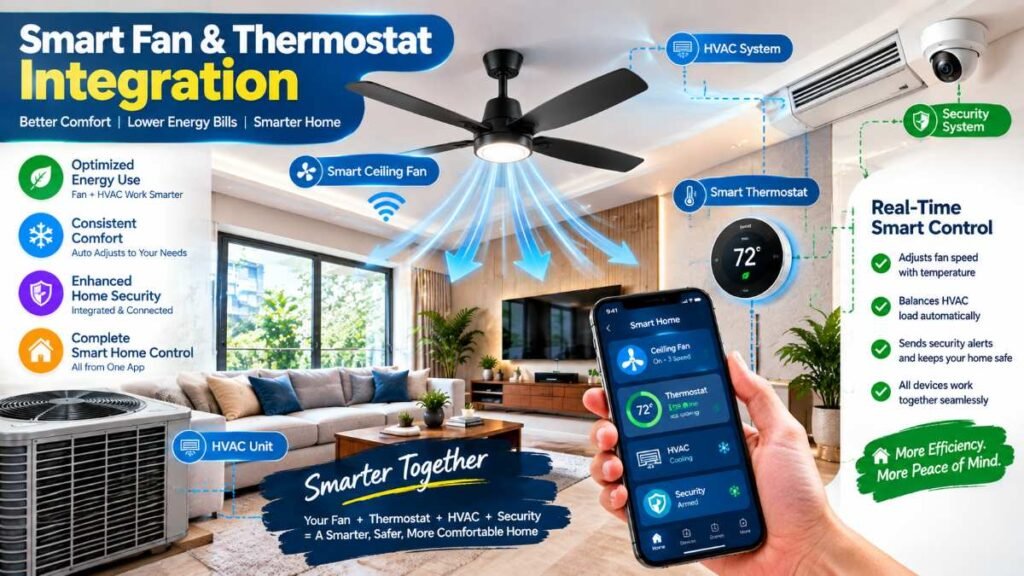
Pairing fan activation with remote temperature sensors allows overhead blades to engage automatically when ambient room temperatures rise. Initiating air movement first helps delay demanding central air compressor cycles, effectively managing energy consumption during expensive peak tariff hours. For optimal climate coordination strategies, check out our best smart thermostats guide.
Occupancy Simulation for Home Security
Integrated LED light engines can imitate real occupancy while you travel. By programming fixtures to toggle on and off at natural, randomized intervals, your living space appears occupied from the exterior. For complete entryway security recommendations, read our evaluation of the best smart locks.
To protect connected hardware from external network intrusions, review our smart home cybersecurity resource. For additional layout ideas, browse our broader smart home automation guide.
Troubleshooting & Routine Hardware Maintenance
Even high-grade motorized hardware requires occasional network calibration and physical maintenance to operate at peak efficiency year-round.
Operational Issue | Likely Root Cause | Recommended Corrective Action |
Connectivity Drop / Unresponsive State | Attenuated wireless signal or Thread mesh coverage gap | Relocate your nearest Thread Border Router closer or assign a static local IP lease |
Physical Oscillations & Operational Humming | Loose motor housing screws or uncalibrated blade weight distribution | Tighten all structural mounting fasteners and attach a clip-on blade balancing kit |
Integrated Light Flickering | Incompatible legacy wall dimmer switch wired in series | Remove legacy wall dimmers completely and install dedicated wireless scene controllers |
Automation Desynchronization | Expired cloud tokens or hub connectivity resets | Configure schedules to run locally directly within your primary smart hub settings |
Step-by-Step Installation Roadmap
Replacing a traditional fixture with a smart ceiling fan follows standard electrical steps, supplemented by local network onboarding.
[1. CIRCUIT ISOLATION] —> [2. RATING VERIFICATION] —> [3. HARNESS WIRING]
De-energize main panel; Confirm fan-rated Join Hot, Neutral,
verify zero voltage outlet box Ground & Light leads
|
v
[5. NETWORK ONBOARDING] <— [4. HARDWARE ASSEMBLY] <———–+
Scan Matter setup code; Mount motor housing,
test local execution blades & light kit
- Circuit Isolation: De-energize power at the main breaker panel and verify the circuit is completely dead using a non-contact voltage tester.
- Structural Rating Verification: Ensure your electrical outlet enclosure is securely anchored directly to ceiling framing and explicitly rated for dynamic ceiling fan loads.
- Terminal Wire Connections: Fasten the supply, neutral, earth, and lighting wires together securely with appropriate wire nuts.
- Hardware Assembly: Secure the downrod, motor housing, blades, and LED module, tightening fasteners evenly to prevent operational wobble.
- Network Onboarding: Restore main power, open your primary ecosystem application, scan the Matter setup QR code, and verify local control responsiveness.
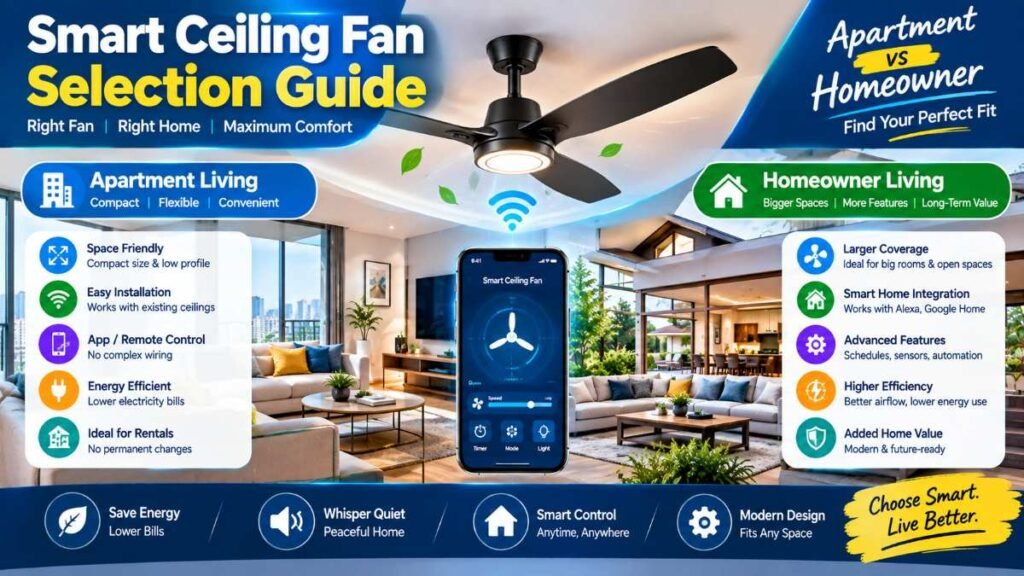
Housing Framework: Renters vs. Homeowners
Your living arrangement dictates the most practical path when upgrading to a smart ceiling fan:
For Renters & Apartment Dwellers
- Retrofit existing fixtures with smart wall switches or wireless RF controllers that add connected capabilities without replacing landlord-owned property.
- Opt for plug-and-play inline modules that leave original wiring intact for effortless removal when transitioning to a new apartment.
For Homeowners & New Construction
- Install native Thread or Wi-Fi BLDC smart ceiling fan units featuring fully integrated, dimmable LED arrays.
- Choose wet-rated or damp-rated outdoor models to maintain optimal air movement across covered patios, verandas, and sunrooms.
Frequently Asked Questions
Q1. Can a smart ceiling fan actually lower my electric bill?
Yes. By pairing an efficient smart ceiling fan with your thermostat, you can raise your AC by 4°F without losing comfort. This simple adjustment cuts summer cooling costs by up to 12%.
Q2. Are smart ceiling fans worth it over traditional fans?
A smart ceiling fan uses ultra-low-wattage BLDC motors and dynamic scheduling. It offers instant voice control, automated climate response, and lower long-term energy draw than legacy AC-motor fans.
Q3. Do I need a special wall switch to install a smart fan?
No. Most modern smart ceiling fan models operate wirelessly via Matter or Wi-Fi. You just need standard electrical wiring and a fan-rated UL ceiling box for secure mounting.
Q4. Can I control a smart fan with Apple Home, Alexa, or Google?
Yes. Matter-compatible smart ceiling fan units seamlessly sync across Apple Home, Amazon Alexa, and Google Home, allowing effortless multi-device control and local automation.
Q5. How do I choose the right smart fan size for my room?
Rooms under 100 sq. ft. need a 36–44 inch blade sweep, while open spaces over 400 sq. ft. require 60-inch blades to maximize airflow efficiency and cooling performance.
🚀 Optimize Your Indoor Climate Today
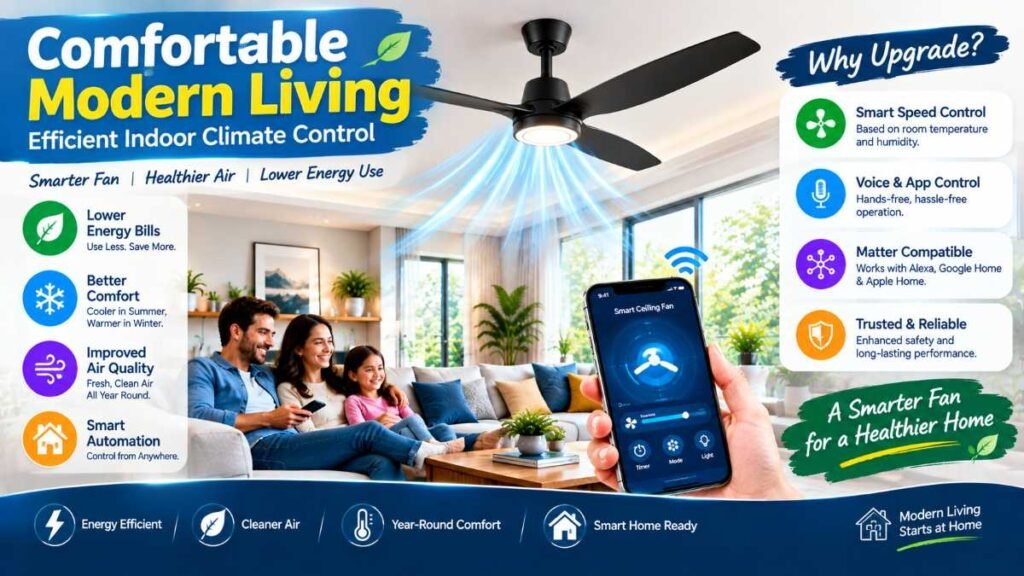
Ready to elevate your home’s air distribution? Choose a Matter-compatible smart ceiling fan, pair it with your primary smart home controller, and build automated routines that keep your living space cool, quiet, and energy-efficient year-round.
Editorial Disclaimer & Evaluation Guidelines
This guide is developed independently for educational and home planning purposes. Product specifications, ceiling box load limits, and protocol behavior vary by manufacturer. Always consult a licensed electrician and adhere to local electrical codes before installing high-voltage fixtures.
About the Author
Dambar C.Rajbanshi. is a home optimization writer and space analyst focused on practical layout efficiency, modern home automation, and energy-saving setups. He researches residential climate control strategies to help homeowners build comfortable, secure, and highly efficient living spaces.