
Imagine standing in the shower, fully lathered up, when a sudden blast of ice-cold water hits you because someone turned on the dishwasher downstairs. We’ve all been there, and that sudden shock is exactly why most people start looking for a tankless water heater. But is going on-demand actually worth the heavy price tag? Let’s break down the real-world math, surprise utility upgrades, and when sticking with a tank is actually smarter.
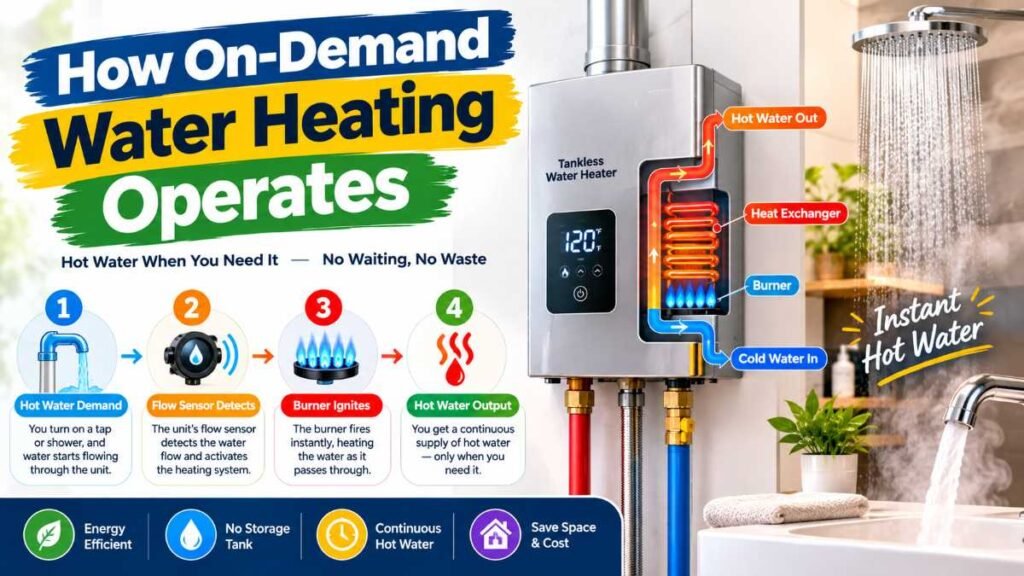
How On-Demand Water Heating Operates
Traditional water heaters continuously maintain 40 to 80 gallons of water at high temperatures 24 hours a day, incurring constant standby heat loss through the tank walls.
On-demand units remove the storage vessel completely. When a hot water tap is opened, flow sensors detect movement and activate either a high-output gas burner or electric resistance elements. Cold water flows through a compact heat exchanger, rising to the target setpoint (typically 120°F) before traveling to the fixture.
Stage | Trigger / Action | System Process |
1. Demand Trigger | Hot water tap opens | Flow sensor detects water movement inside the inlet pipe |
2. Ignition / Power | System activation | Gas burner ignites or electric heating elements energize |
3. Thermal Transfer | Cold water flows through heat exchanger | Water temperature rapidly scales to setpoint (e.g., 120°F) |
4. Output Delivery | Continuous supply | Heated water travels directly to active fixture |
By heating water only during active demand, these units eliminate standby losses. According to official test metrics from the U.S. Department of Energy (Energy Saver), demand water heaters can be 24% to 34% more energy efficient than conventional storage tank units for homes that use 41 gallons or less of hot water daily.
Gas vs. Electric On-Demand Systems
Selecting between natural gas/propane and electric power sources depends heavily on your property’s existing utilities.
System Parameter | Gas-Fired Tankless Systems | Electric Tankless Systems |
Primary Advantage | High flow rates (GPM) suitable for whole-home use | Lower upfront equipment costs & simpler unit placement |
Utility Requirement | Gas-line capacity sized to BTU demand & proper venting | Dedicated circuit breakers & ample electrical panel capacity |
Venting Needs | Direct venting (PVC, CPVC, or Category III stainless) | None required |
Best Climate Fit | Northern & cold climate zones with low groundwater temps | Southern / warm groundwater zones or small homes/condos |
Gas-Fired Systems
Gas units deliver high gallon-per-minute (GPM) flow rates, making them suitable for whole-home applications in cold regional climates.
- Requirements: Gas-line sizing must be calculated from the heater’s input rating (often ranging between 160,000 to 199,000 BTUs/hr), pipe length, gas type, and the home’s total connected gas load. Some retrofits require larger or dedicated gas piping alongside direct exhaust venting.
- Performance: Higher flow capacity; suited for simultaneous shower and appliance usage.
Electric Systems
Electric units use submerged heating elements to transfer thermal energy directly to passing water.
- Requirements: Substantial electrical infrastructure. Some whole-house electric tankless models can require 100+ amps of dedicated electrical capacity, with exact requirements varying by model and heating capacity (frequently utilizing multiple double-pole breakers).
- Performance: Lower initial cost and simpler installation, but flow rates drop significantly in regions with cold winter groundwater.
What I Would Check Before Buying: A Real-World Checklist
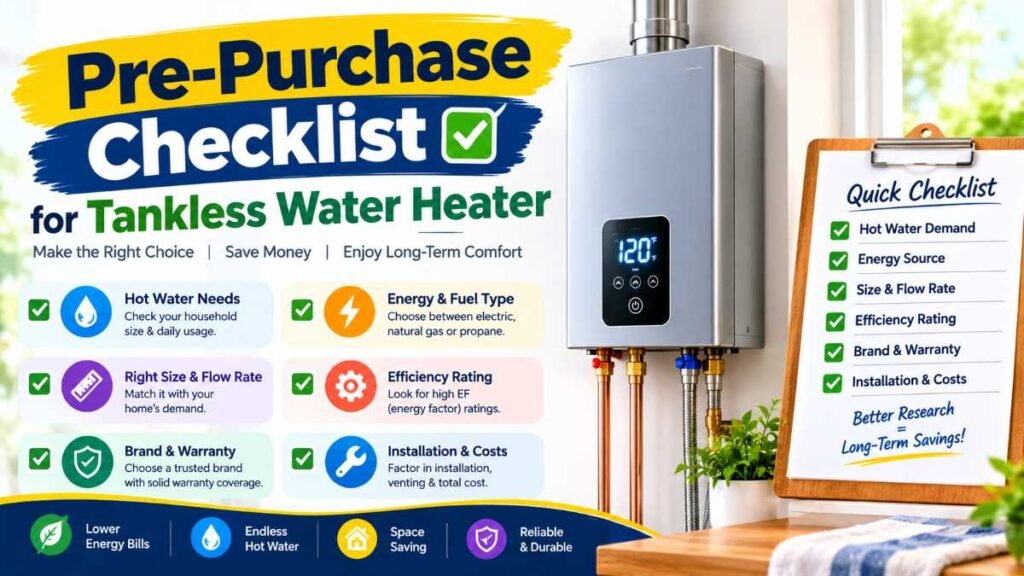
Before spending thousands on an upgrade, walk through this pragmatic decision framework to determine if your home infrastructure is truly ready for a Tankless Water Heater Guide installation plan:
A few months ago, a client in Chicago bought a high-output gas unit online thinking it would be a simple swap. They were shocked when the installer quoted an extra $2,200 just to upsize their main gas line from 1/2″ to 3/4″ pipe. Running through this basic checklist beforehand would have saved them from that costly surprise.
- Incoming Groundwater Temperature: Test or look up your regional groundwater baseline. Cold northern groundwater severely cuts down a unit’s output volume.
- Simultaneous Shower Demand: Count how many hot-water fixtures run at the exact same time during peak morning routines.
- Gas Line Capacity or Electrical Panel Limit: Check whether your gas line has sufficient diameter/pressure, or if your main electrical panel has available capacity for high-amperage breakers.
- Venting Clearance & Wall Paths: Confirm where the exhaust pipes will exit through the exterior wall and make sure local codes allow the required clearance distance.
- Local Utility Rates: Compare local therm costs for natural gas against per-kWh electric rates to calculate your true payback timeline.
- Expected Years in the House: If you plan to move within 3 to 5 years, high installation costs will outweigh operational energy savings.
Honest Advice: If your existing storage tank is working fine and your household rarely runs out of hot water, replacing it purely for energy savings usually does not make financial sense.
System Sizing: Calculating GPM and Temperature Rise
Avoid sizing an on-demand unit based on household square footage. Systems must be calculated using two factors: Gallons Per Minute (GPM) and required Temperature Rise.
Step 1: Calculate Peak Flow Rate (GPM)
Add up the flow rates of all fixtures that might run at the exact same time:
- Standard showerhead: 1.5 to 2.5 GPM
- Kitchen sink faucet: 1.5 to 2.0 GPM
- Clothes washer: 1.5 to 2.0 GPM
- Dishwasher: 1.0 to 1.5 GPM
Example: Running a shower (2.0 GPM) and a kitchen sink (1.5 GPM) concurrently requires a minimum system output of 3.5 GPM.
Step 2: Calculate Required Temperature Rise
Temperature rise is the difference between incoming groundwater temperature and your desired output temperature (usually 120°F).
In Southern regions where groundwater averages 65°F–70°F, achieving 120°F requires a modest 50°F–55°F rise. In Northern regions where winter groundwater can drop to 40°F, the unit must achieve an 80°F rise, which lowers the maximum GPM output of the heater.
Which System Is Right for You?
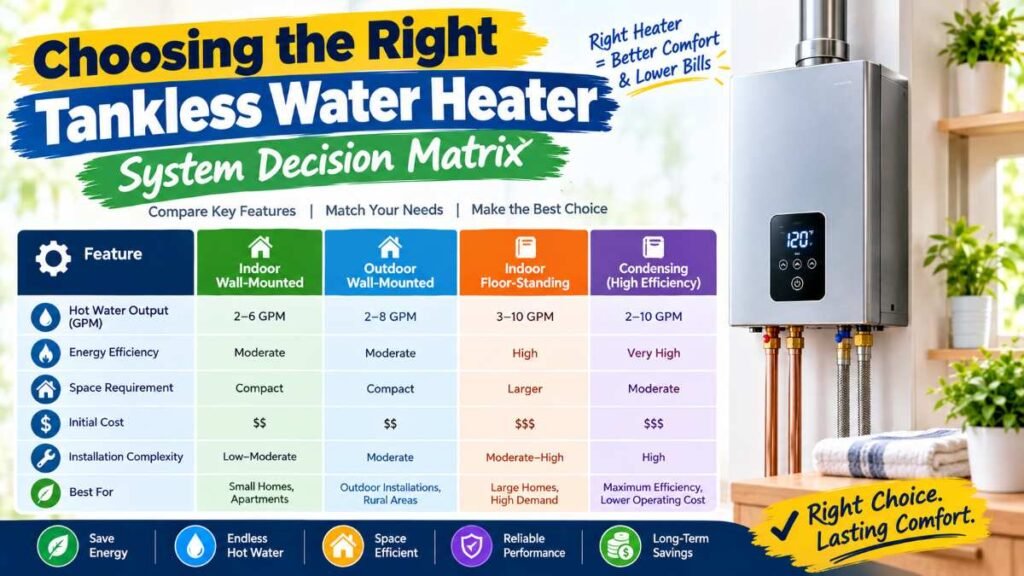
Typical U.S. installed-cost ranges shown below are planning estimates, not contractor quotes. Actual pricing varies by region, equipment, labor, permitting, venting, gas/electrical upgrades, and installation complexity.
System Type | Typical Installed Cost | Expected Service Life | Uniform Energy Factor (UEF) | Primary Application |
Gas On-Demand | $3,000 – $5,500 | 15–20+ Years | 0.81 – 0.96 UEF | Medium to large homes with existing gas service |
Electric On-Demand | $1,800 – $3,200 | 15–20 Years | ~0.98 UEF | Small homes, condos, or warm groundwater zones |
Standard Storage Tank | $1,300 – $2,300 | 8–12 Years | 0.60 – 0.70 UEF | Budget-conscious, direct replacement retrofits |
Hybrid Heat Pump | $2,500 – $4,200 | 10–15 Years | up to 3.5–4.0 UEF | All-electric homes prioritizing lowest operating costs |
Note: For all-electric households evaluating maximum operational savings, review our detailed guide on selecting a heat pump water heater certified under ENERGY STAR® Product Criteria.
Quick Decision Matrix
Home Situation | Best Starting Point |
Existing gas + high simultaneous demand | Gas tankless |
Warm groundwater + limited electrical demand | Electric tankless |
All-electric home + low operating cost priority | Heat-pump water heater |
Low upfront cost / simple replacement | Standard storage tank |
Existing heater works well + low hot-water demand | Keep existing system |
Infrastructure Requirements & Upgrades
The initial retail price of an on-demand unit represents only a portion of the total project expense. Older homes often require infrastructure modifications to handle the increased instantaneous load.
Electrical Panel Service
Whole-house electric units require substantial dedicated amperage. If your property operates on a 100-amp or 150-amp main service panel, upgrading to a 200-amp or 300-amp panel may be necessary. If your overall home project involves utility panel upgrades or adding heavy loads like a home EV charger installation, coordinate panel sizing with a licensed electrical contractor before buying equipment.
Gas Line Sizing
A traditional 50-gallon gas tank heater typically consumes 35,000 to 50,000 BTUs per hour. Conversely, a whole-home gas on-demand unit requires 160,000 to 199,000 BTUs per hour to heat water instantly. Connecting a high-BTU unit to an undersized gas pipe can starve both the water heater and adjacent gas appliances.
Venting and Plumbing Adjustments
Non-condensing gas units require Category III stainless steel exhaust piping to withstand high temperatures and corrosive condensation. Condensing units allow PVC/CPVC venting but require a dedicated drain line for acidic condensate disposal. When modifying supply piping or adding required isolation valves, reviewing guidelines for emergency plumbing repair can help prevent unexpected leaks during system conversion.
Manufacturer-First Maintenance & Descaling
While on-demand units do not store water, mineral deposits (calcium and magnesium scale) accumulate inside the heat exchanger over time—especially in hard water regions. Following a structured Tankless Water Heater Guide descaling schedule prevents efficiency drops.
Order | Maintenance Phase | Core Activity |
1 | Documentation | Review unit manual for model-specific chemical and pump guidelines |
2 | Isolation | Disconnect electrical power/gas supply; close water service valves |
3 | Descaling | Circulate food-grade vinegar or approved descaler via submersible pump |
4 | Filter Service | Remove and clean inline cold-water inlet screen under running water |
5 | System Restoration | Flush exchanger with clean water, purge air, restore power and fuel lines |
Smart Controls and Automation Integration
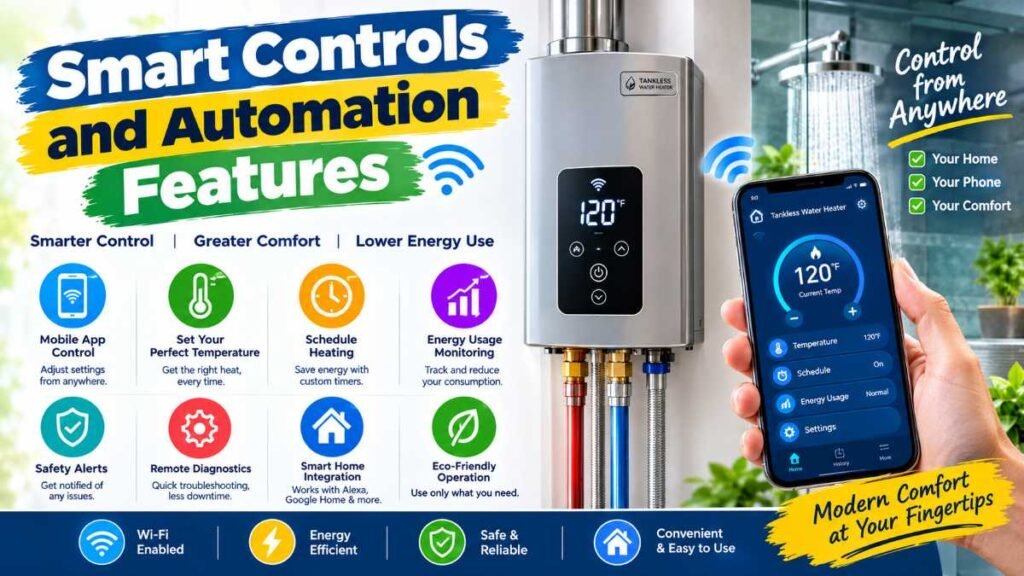
Modern tankless units often feature Wi-Fi monitoring, digital temperature adjustment, and integration with smart home ecosystems.
Integration Capabilities:
- Demand-Based Recirculation: On-demand units can take 15 to 45 seconds to clear standing cold water from long pipe runs. Smart recirculation pumps can be triggered via motion sensors or app schedules so hot water is ready when you enter the bathroom.
- Leak Detection & Security: Connecting auto shut-off valves and leak sensors near plumbing connections protects against water damage. To protect connected appliances on your local network, reference our checklist for smart home cybersecurity.
- Energy Optimizations: For homes focused on reducing energy waste alongside structural upgrades like energy efficient windows, optimizing recirculation schedules helps prevent unnecessary burner activations. Use the temperature setting recommended for your household and local code. Higher water temperatures can increase scald risk, while Legionella control may require a different water-management strategy in some systems.
When You Should NOT Buy a Tankless Water Heater
To make an informed decision using this Tankless Water Heater Guide, it helps to understand scenarios where a tankless heater may not be the right fit:
- You Have High Electrical Upgrade Costs: If installing an electric tankless unit requires a main panel upgrade ($2,500+) and long wire runs, a hybrid heat pump water heater often provides lower operating costs at a fraction of the installation complexity.
- You Have Extremely High Simultaneous Demand: If your household regularly runs three showers, a washing machine, and a dishwasher at the exact same time in a cold northern climate, a single tankless unit may struggle to maintain target temperatures without installing two units in parallel.
- Short-Term Property Ownership: If you plan to sell your home within 2 to 4 years, the energy savings will likely not offset the higher upfront installation costs.
Frequently Asked Questions
Q1: What is the downside to a tankless water heater? High upfront costs and extra utility upgrades (gas lines or electrical panels). Cold climates can also strain undersized units during peak usage.
Q2: How to choose the correct tankless water heater? Ignore square footage. Size your tankless water heater strictly using required GPM (flow rate) and temperature rise (groundwater vs output temp).
Q3: What size tankless water heater is best for a family of four? Aim for a tankless water heater delivering 6.0–9.0 GPM (180k+ BTU) to easily handle two showers and a dishwasher at once.
Q4: What is the most common problem with tankless water heaters? The “cold water sandwich”—a quick burst of cold water after turning a warm tap off and on.
Field Note: I hit this daily while shampooing with a non-buffer tankless water heater; pausing flow causes a brief freeze before hot water returns. Buffer-tank models fix it.
Final Recommendation
Consulting this Tankless Water Heater Guide makes sense if you have a multi-person household with sequential hot water demands, plan to stay in your home long enough to benefit from an extended service life, or want to free up square footage in a mechanical room.
However, if your installation requires extensive utility work—such as running new gas mains or completing a main electrical panel replacement—evaluating high-efficiency standard tanks or hybrid heat pump systems will ensure you select the best solution for your budget.
Safety & YMYL Disclaimer:
Installing or servicing water heaters involves high-voltage electricity, combustible natural gas/propane, and high-pressure plumbing connections. Always consult a licensed local plumber and electrician to verify compliance with the National Electrical Code (NEC) and local building codes. Never perform internal electrical or gas modifications yourself.
Author: Dambar C. Rajbanshi
About Author: A renovation strategist and home improvement enthusiast. Dambar specializes in budget-smart planning and functional kitchen and utility space design, dedicated to helping homeowners create practical, cost-effective spaces.
Last Updated: 2026 Edition