
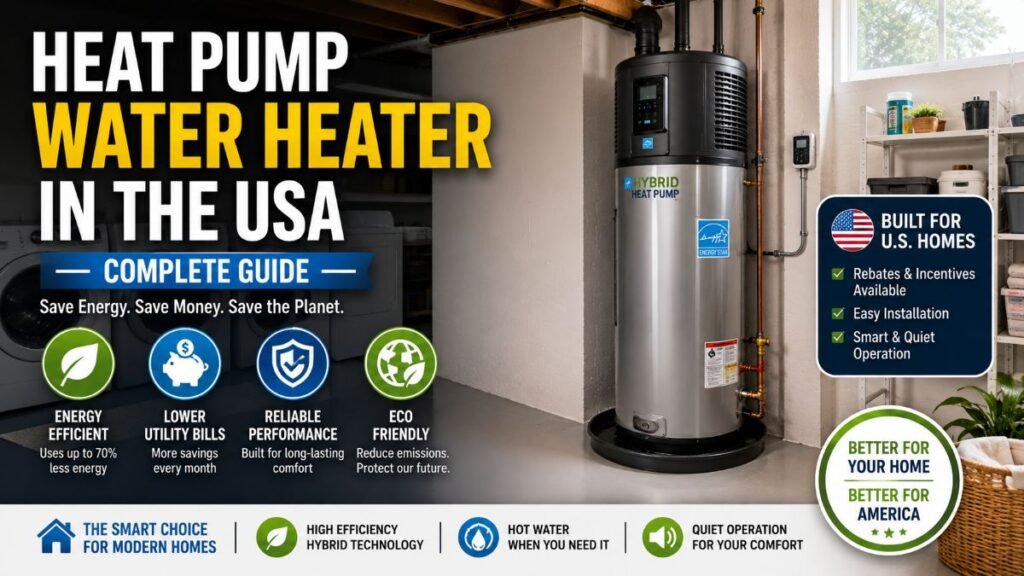
Struggling with high electric bills? Water heating accounts for nearly 18% of the average U.S. home’s energy use—making it one of your biggest hidden expenses.
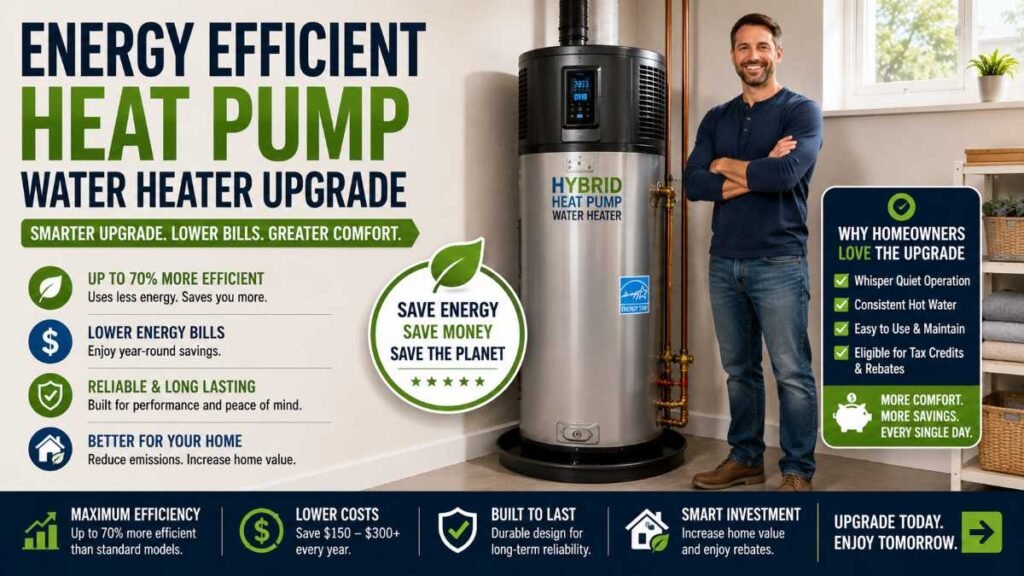
Switching to a heat pump water heater in the USA can slash that energy consumption by up to 70% without compromising on hot showers. By capturing surrounding heat instead of burning power, this simple upgrade saves homeowners hundreds every year. Ready to cut costs? Here is your complete, code-compliant guide to making the switch.
How a Modern heat pump water heater in the USA Operates
Unlike standard electric tank water heaters that use direct electrical resistance elements to heat stored water, a modern hybrid unit functions much like a refrigerator operating in reverse.
An integrated top-mounted compressor and evaporator fan pull warm ambient air from the surrounding utility room, basement, or garage. The internal refrigerant cycle absorbs this ambient heat and transfers it directly to the stored water through a wrapped heat exchanger.
Heating Mode | Energy Source | Primary Use Case | Efficiency Level |
Hybrid Mode | Heat Pump + Resistance Backup | Daily standard operation | High Efficiency |
Pure Heat Pump | Ambient Air Only | Moderate use / warm seasons | Ultra-High Savings |
Electric Resistance | Dual Elements | Rapid recovery / high demand | Standard (1x Efficiency) |
Vacation Mode | Minimal standby | Extended periods away | Lowest Energy Consumption |
During peak demand periods—such as multiple back-to-back morning showers in freezing winter months—the system automatically engages backup electric resistance elements. This dual-action design ensures your household experiences uninterrupted hot water delivery regardless of external weather conditions.
Federal Tax Credits, Rebates, and Incentives
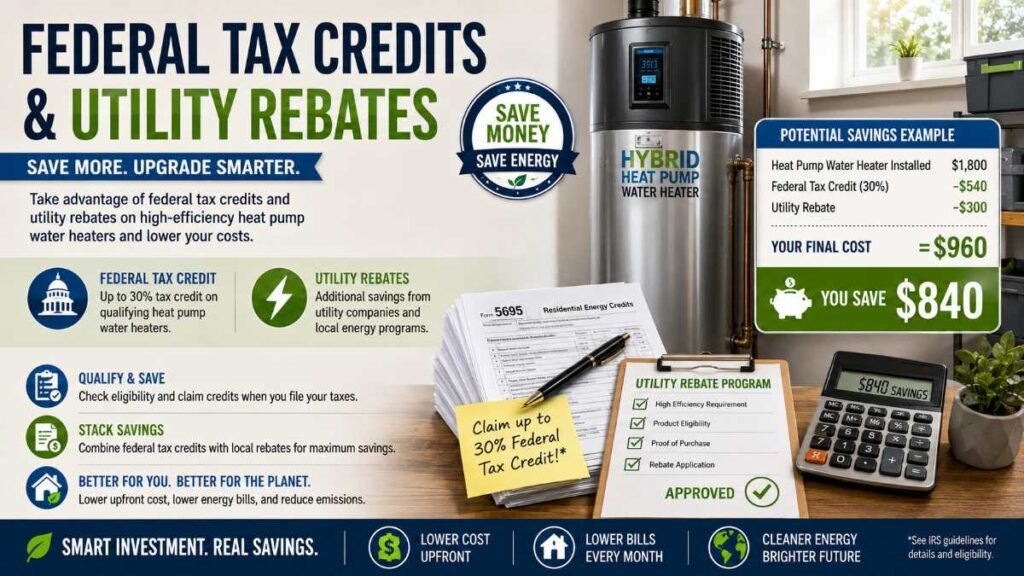
Navigating government incentives requires careful timing because federal guidelines update regularly. Homeowners planning to buy a heat pump water heater in the USA in 2026 should verify the latest rules before finalizing their installation budget.
- Previous Federal Framework: Under prior IRS updates, qualifying hybrid water heaters qualified for a 30% Energy Efficient Home Improvement Credit (Section 25C), capped at $2,000 annually.
- Current Guidance Verification: Because federal tax code provisions evolve, always check current IRS announcements alongside state and local utility rebate programs. Local electric utilities frequently offer instant rebates ranging from $500 to $1,500 for qualifying ENERGY STAR certified units.
- Important Planning Note: Do not assume a federal tax credit is automatically active for your 2026 installation without confirming current IRS eligibility criteria and program funding caps.
For official updates on clean energy home retrofits, reviewing guidance from the U.S. Department of Energy Energy Saver Guide is an essential first step.
Real-World Cost Analysis: Upfront Investment vs. Long-Term Savings
While the initial price tag of a hybrid water heater is higher than a standard electric storage tank, analyzing multi-year operational expenses demonstrates a fast return on investment.
Expense Category | Standard Electric Tank | Heat Pump Water Heater |
Typical Equipment Cost | $700 – $1,200 | $1,600 – $2,800 |
Typical Installation Labor | $400 – $800 | $800 – $1,500 |
Average Annual Electricity Cost | $550 – $750 | $150 – $250 |
Payback Period | N/A | 2 to 4 Years (depending on rates/rebates) |
Estimated Lifespan | 8 – 12 Years | 10 – 15 Years |
In my client consultations, homeowners saving $350 to $500 annually on electricity bills routinely offset the initial price premium within 3 years. Over the unit’s 10-to-15-year lifespan, total net savings can easily exceed several thousand dollars.
Space Requirements and Airflow Logistics
Installing a hybrid water heater requires planning for space volume, ambient conditions, and moisture management that differ from simple direct replacement tanks.
- Air Volume Requirements: Heat pumps require at least 700 to 1,000 cubic feet of surrounding unconditioned air space (roughly equivalent to a 10′ x 10′ room) to draw sufficient heat energy. If installing in a compact closet, louvered doors or ducting kits are mandatory.
- Ambient Temperature Range: Optimal performance occurs in locations that remain between 40°F and 90°F year-round. Unheated basements and attached garages are usually ideal locations.
- Condensate Drainage: As the heat pump cools surrounding air, moisture condenses out of the atmosphere. You must install a dedicated condensate drain line leading to a floor drain or connect a automatic condensate pump.
When retrofitting your utility space, consider pairing this upgrade with broader efficiency projects like installing Energy Efficient Windows to maximize whole-home thermal efficiency.
Electrical Wiring and Panel Considerations
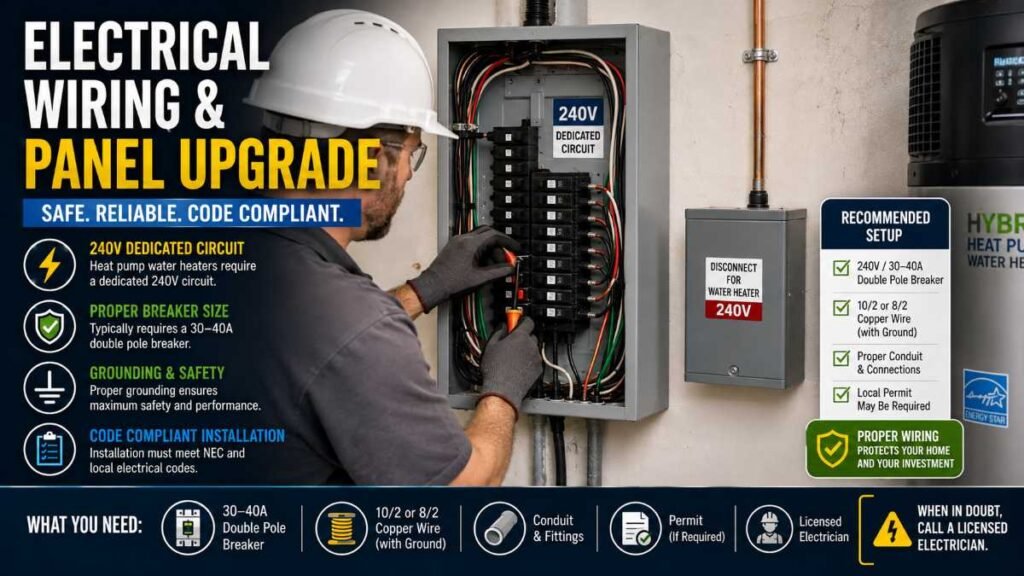
Verifying electrical panel capacity is critical when evaluating a heat pump water heater in the USA retrofitting project.
- Standard 240V Connections: Most standard hybrid units require a dedicated 240-volt, 30-amp circuit, which is identical to conventional electric water heaters.
- Gas-to-Electric Conversions: Converting from natural gas or propane to electricity requires running a new 240V line from your breaker box, which requires professional electrical work.
- 120V Plug-In Alternatives: Newer 120-volt shared-circuit models can plug directly into standard 15A or 20A wall outlets. While these take longer to recover during heavy hot water use, they eliminate the need for expensive panel upgrades.
If your water heater replacement is part of a broader mechanical room overhaul, review our guide on Emergency Plumbing Repair to ensure your home’s main water lines are fully up to code.
Simple Maintenance Best Practices
Maintaining peak operational efficiency and protecting your manufacturer warranty requires just a few minutes of periodic maintenance each year.
- Air Filter Cleaning: Check and wash the top-mounted air intake mesh filter every 3 to 6 months. A clogged filter starves the compressor of air, forcing the system onto inefficient electric resistance mode.
- Anode Rod Inspection: Inspect the sacrificial anode rod every 3 years. Replacing a depleted anode rod prevents interior tank rust and extends overall system life significantly.
- Annual Tank Flushing: Drain a few gallons from the bottom drain valve yearly to flush out mineral sediment buildup, particularly in regions with hard water.
Organizing your utility zone makes routine maintenance much easier; explore our clever Laundry Room Storage Ideas to keep clear access pathways around your mechanical equipment.
Technology Comparison: Heat Pump vs. Gas vs. Tankless
Selecting the right water heater depends on your household energy setup, local climate, and utility pricing structures.
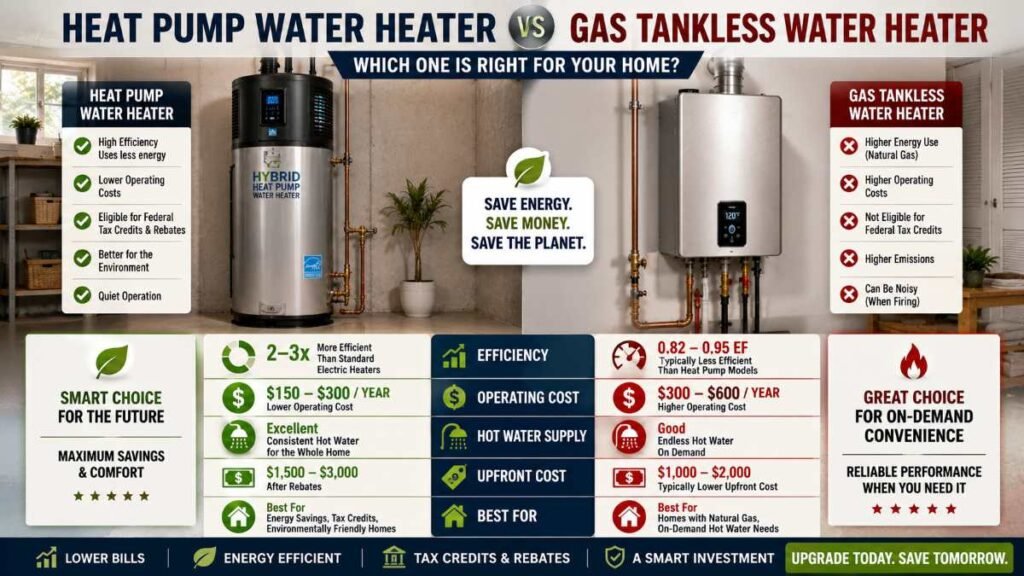
- Vs. Tankless Gas Units: Gas tankless heaters provide continuous hot water but rely entirely on fossil fuels. Heat pumps run on electricity, making them ideal for homes paired with solar panels or committed to decarbonization.
- Vs. Standard Electric Storage: Conventional electric resistance water heaters are cheap upfront but expensive to operate. Hybrid heat pumps consume up to 70% less electricity, delivering substantially lower utility bills year after year.
Integrating high-efficiency mechanicals into a modern smart building setup creates a future-proof utility space. Learn how connected systems work together in our comprehensive guide to Smart Home Automation.
Smart Connectivity and Grid-Interactive Features
Modern hybrid water heaters feature built-in Wi-Fi and smartphone app integration, allowing homeowners to optimize performance remotely.
- App-Controlled Scheduling: Lower energy consumption while away by setting vacation mode from your smartphone, or schedule high-demand heating cycles during off-peak electricity hours.
- Demand-Response Integration: Many U.S. utility companies offer monetary incentives for enrolling smart water heaters in load-management programs, which subtly adjust heating cycles during extreme summer grid demand.
To connect your mechanical appliances into a central automation setup, check out our curated guide on the Best Smart Home Devices to build a fully automated home environment.
People Also Ask (FAQ)
What does a heat pump water heater do?
It absorbs warmth from surrounding air to heat household water, cutting annual electric consumption drastically.
How does a water heat pump work?
A built-in compressor pulls heat from ambient air into your tank, making a heat pump water heater in the USA run on far less energy.
Are heat pump water heaters worth the extra cost?
Yes. Higher upfront prices and space needs are quickly offset by massive annual utility bill savings, making a heat pump water heater in the USA a smart long-term investment.
Do experts recommend switching to a heat pump water heater?
Energy experts strongly recommend them to lower operating costs, though true ROI depends on local electricity tariffs, unit sizing, and available rebate incentives for a heat pump water heater in the USA.
Conclusion: Is a Heat Pump Water Heater Worth It?
Investing in a modern heat pump water heater in the USA offers one of the highest returns on investment of any residential energy upgrade. By significantly lowering monthly electric costs, offering smart app management, and reducing carbon emissions, hybrid water heaters represent the modern standard for home heating efficiency.
Ready to cut your energy bills? Verify your local utility rebates, consult a qualified installer, and upgrade your home’s water heating system today!
Authoritative References & Further Reading
- Verify model efficiency ratings on the official ENERGY STAR Certified Water Heaters Product Finder.
- Explore federal energy guidelines via the U.S. Department of Energy Energy Saver Guide.
Author By: Dambar C. Rajbanshi About: A renovation strategist and home improvement enthusiast. Dambar specializes in budget-smart planning and functional kitchen design. He is dedicated to helping homeowners create spaces that perfectly balance beauty and practicality