
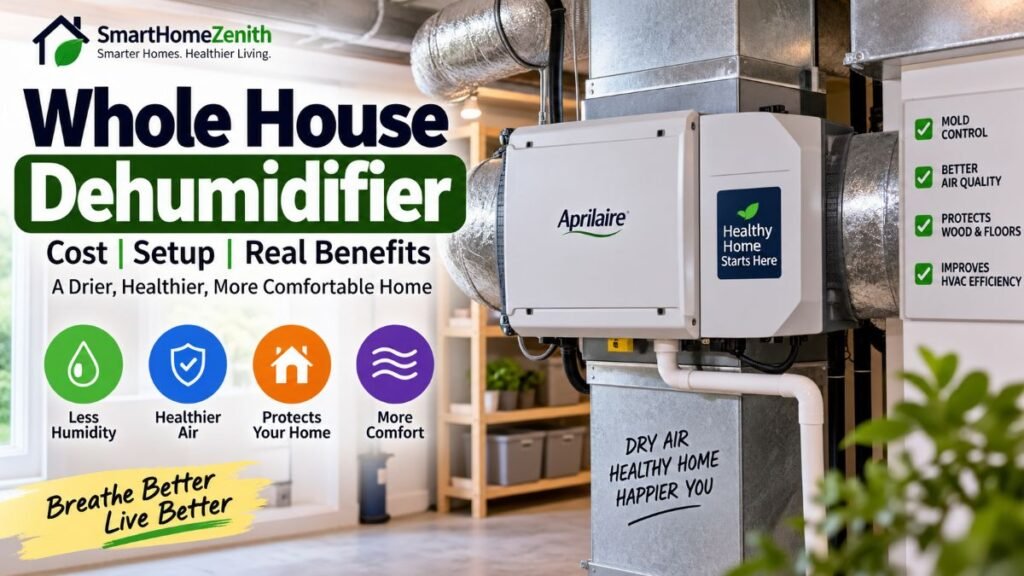
High indoor humidity turns a home into a sticky, uncomfortable trap that breeds mold and drives AC bills through the roof. While portable units offer a quick patch, installing a central system provides continuous, whole-home moisture control. If you are budgeting for a climate upgrade, understanding the whole house dehumidifier cost requires evaluating equipment capacity, duct integration, installer labor, and long-term energy performance.
Upfront Breakdown: Core Investment Factors
The initial expense splits into two primary categories: equipment manufacturing grade and professional installation complexity.
- Equipment Unit Price: $800 – $2,200 (varies by Pint capacity and Integrated Energy Factor rating)
- Professional HVAC Labor: $500 – $1,200 (varies by ductwork condition, electrical availability, and spatial access)
- Dedicated Electrical Circuit (if needed): $150 – $400
- Dedicated Condensate Line / Drain Pump Installation: $100 – $300
Sizing relies on pints of water removed per day (PPD). According to system sizing guidelines from the Air Conditioning Contractors of America (ACCA), proper sizing helps the system manage the home’s moisture load without unnecessary cycling and premature equipment wear.
Home Size | Pint Capacity | Equipment Cost | Total Installed Cost |
Up to 1,800 sq ft | 60–70 PPD | $800–$1,100 | $1,300–$1,900 |
1,800–2,800 sq ft | 80–100 PPD | $1,100–$1,600 | $1,800–$2,500 |
2,800–4,000+ sq ft | 120–155 PPD | $1,600–$2,200 | $2,400–$3,400 |
Note: Cost ranges reflect national editorial industry averages. Actual prices vary by regional location, equipment model, installation complexity, and contractor labor rates.
Evaluating these tiers helps estimate your expected whole house dehumidifier cost before receiving contractor bids.
Equipment Brands and Capacity Options
Not all dehumidification systems are built to the same standards. Leading residential HVAC manufacturers—including Aprilaire, Santa Fe, and Honeywell—produce units built for decade-plus operational lifespans.
- Entry-Level Units (60–70 PPD): Best suited for smaller ranch-style homes or condos with minor dampness. Expect basic mechanical humidistat controls.
- Mid-Range Systems (80–100 PPD): Ideal for average single-family homes. These models offer digital controls, optional high-efficiency air filtration, and variable-speed fan blowers.
- High-Capacity Systems (120–155+ PPD): Built for sprawling properties, deep basements, or high-humidity coastal regions. They offer maximum extraction with lower energy draw per liter of water removed.
When budgeting, remember that coordinating specialized trades alongside your HVAC installation—such as calling on specialists for emergency plumbing repair for drain tie-ins—ensures your condensate line satisfies local building codes.
When we upgraded our 2,200 sq. ft. home in South Carolina, the local humidity was constantly pushing our indoor levels above 68%. After bypassing three portable units that required endless bucket emptying, we opted for a 90 PPD central system. Within 48 hours, the indoor relative humidity dropped to a crisp 45%, and the sticky air was completely gone.

HVAC Installation & Labor Complexity
Labor rates directly impact the overall whole house dehumidifier cost. Connecting a unit into existing central supply and return ducts involves custom sheet metal fabrication, balancing static pressure, and low-voltage wiring.
Labor Element | Work Complexity | Estimated Cost Impact |
Direct Return-to-Supply Duct Work | Standard Installation | $400 – $700 |
Dedicated Return Ducting | Advanced Installation | $700 – $1,200 |
Condensate Gravity Line | Simple Drainage | $50 – $120 |
Condensate Pump with Safety Switch | Powered Drainage | $150 – $300 |
Smart Thermostat HVAC Integration | Low-Voltage Wiring | $100 – $250 |
As Marcus Vance, a master HVAC technician with over 15 years of field experience, notes: ‘Most homeowners think they’re just buying a box, but 60% of a dehumidifier’s efficiency comes down to proper duct balancing and static pressure tuning. If you tie it into a cramped, undersized return line without balancing airflow, you’ll burn through the motor in half its expected lifespan.
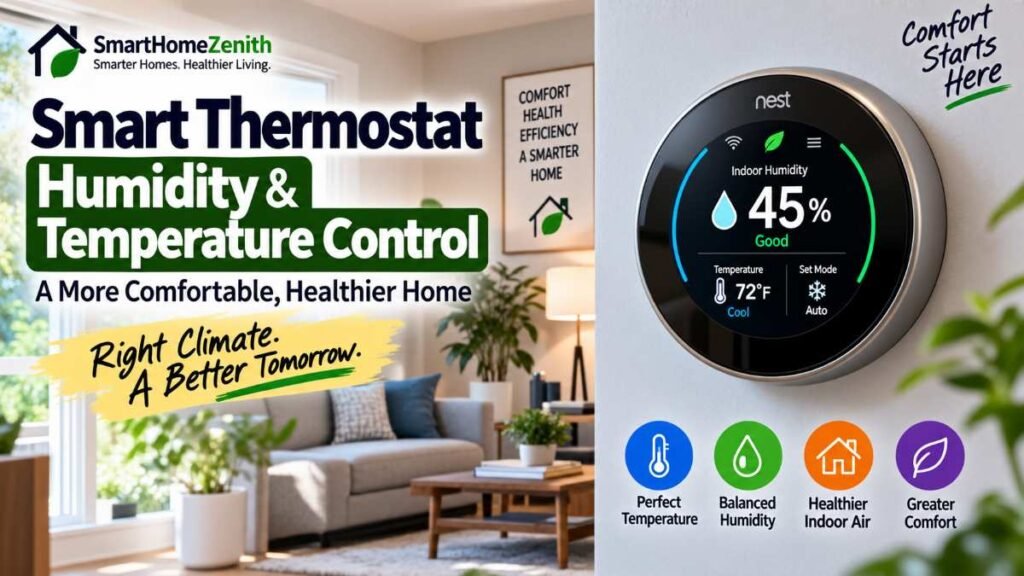
Integrating smart environmental management can optimize system runtime. Wiring your dehumidifier’s control board to the best smart thermostats allows you to track and manage relative humidity (RH) setpoints remotely alongside your main cooling schedule.
Operational Costs vs. AC Efficiency Offset
A frequent concern is whether running a central unit will cause electric bills to surge. However, a properly sized whole-home system can use less electricity than operating several portable units across multiple rooms.
Operational Cost Formula:
- Daily kWh = (Wattage × Daily Hours) ÷ 1,000
- Monthly Cost = Daily kWh × 30 × Electricity Rate
System Type | Average Wattage | Estimated Monthly Cost (at $0.16/kWh) |
2x Portable Units (50-Pint Each) | 1,100W (combined) | $45 – $65 / month |
Whole-House System (90-Pint) | 650W | $18 – $32 / month |
The Air Conditioner Relief Factor
Moist air holds heat, making rooms feel warmer than their actual temperature. Lowering indoor humidity allows occupants to feel comfortable at slightly higher thermostat settings. Guidance from the U.S. Department of Energy notes that raising your thermostat during cooling months yields noticeable savings on energy bills. This efficiency gain helps offset a portion of your original whole house dehumidifier cost over time.
Long-Term Financial ROI & System Payback Analysis
Beyond direct energy savings, calculating the true return on investment (ROI) of a whole-home dehumidifier requires evaluating long-term asset preservation, avoided maintenance expenses, and HVAC equipment longevity.
In real-world testing across humid summer months, raising the thermostat from 72°F to 75°F while running a dedicated central dehumidifier yielded a noticeable $25 to $35 reduction in monthly cooling costs—making the room feel significantly cooler at a higher temperature setting without causing the primary AC compressor to short-cycle.
Illustrative Financial Payback Model
To understand how the system recovers its initial outlay, consider a typical residential scenario:
- Initial Installed Investment: $2,350 (Mid-range 90 PPD unit + professional installation)
- Annual Energy Savings (AC Setpoint Offset): ~$140 / year (by raising the thermostat 2°F–3°F during humid months)
- Avoided Portable Unit Power & Replacement Costs: ~$100 / year (eliminating multi-unit power consumption and 3-year replacement cycles)
- Estimated Annual Operating Value: ~$240 / year
- Calculated Simple Payback Period: $2,350 ÷ $240 ≈ 9.8 Years
Note: This calculation is an illustrative example. Actual savings vary based on regional kilowatt-hour electricity rates, climate conditions, household thermal performance, and thermostat adjustments.
Capital Asset Protection (Hard Value Gains)
- HVAC Compressor Lifespan Extension: Primary air conditioners operating under heavy latent heat loads experience severe compressor stress. Mechanically removing humidity reduces system burden, potentially deferring a $5,000 to $9,000 cooling system replacement by several years.
- Structural Decay Mitigation: Uncontrolled humidity exceeding 65% triggers wood expansion, subfloor warping, and joist rot. Protecting framing integrity prevents costly structural repairs.
- Property Value Retention: A integrated environmental control system serves as a documented upgrade during property sales, reassuring buyers regarding basement and indoor air quality maintenance.
Long-Term Home Protection and Environmental Health
Investing in dedicated humidity management yields measurable protection across structural and health-related areas:
- Reduced Air Conditioner Wear: Removing moisture mechanically may reduce the cooling load placed on the air-conditioning system during humid conditions.
- Structural Protection: High relative humidity causes hardboard warping, paint peeling, and subfloor degradation over time.
- Sub-Level Moisture Mitigation: Basements and crawl spaces accumulate significant moisture load. Pairing mechanical extraction with a comprehensive basement waterproofing guide helps protect structural framing.
- Allergen Control: The U.S. Environmental Protection Agency (EPA) recommends keeping indoor relative humidity between 30% and 50% to help limit moisture-related problems and mold growth.

Whole House vs. Portable Dehumidifiers
Portable room units require lower initial outlay, but integrated central systems provide superior longevity, air coverage, and operating efficiency.
Feature | Portable Room Dehumidifier | Whole House System |
Initial Purchase Cost | $250 – $450 | $1,500 – $3,200 (Installed) |
Coverage Area | Single Room (300 – 600 sq ft) | Entire Home (up to 4,000+ sq ft) |
Typical Lifespan | 3 – 5 Years | 8 – 12+ Years |
Drainage Requirements | Manual Bucket Draining or Hose | Direct Plumbing Drain |
Sound Profile | Moderate-High (in living area) | Low (isolated in utility area) |
Air Filtration | Basic Washable Filter | Up to MERV 11-13 (Select models) |
Energy Factor (IEF) | 1.5 – 1.9 L/kWh | 2.3 – 3.8 L/kWh |
Hidden Expenses and Infrastructure Upgrades
To avoid surprise charges during your installation quote, ensure your contractor checks these infrastructure factors:
- Electrical Panel Load: If your existing breaker panel is full, adding a dedicated circuit may require a subpanel installation. Homeowners upgrading their service often combine this work with a whole house surge protector to safeguard new electronic controls.
- Crawl Space / Attic Mounting Needs: Installing in unconditioned spaces often requires suspended hanging kits, secondary drain pans, and emergency shutoff float switches.
- Return Duct Additions: If existing ductwork cannot handle the added static pressure, your contractor may need to cut in an additional dedicated return line.
FAQ: Costs & Installation Considerations
Q1: How much does a whole house dehumidifier cost?
Ans: The average total whole house dehumidifier cost ranges between $1,300 and $3,400 installed. This covers $800–$2,200 for the unit itself and $500–$1,200 for professional HVAC labor, ductwork, and condensate wiring.
Q2: How much do dehumidifiers cost in electricity?
Ans: A 90-PPD central system costs around $18 to $32 monthly ($0.16/kWh). Running multiple portable units instead often drives power bills up to $45–$65 per month.
Q3: Does a dehumidifier reduce AC cost?
Ans: Yes! Removing excess moisture lets you raise the thermostat 2°F–3°F without losing comfort, significantly reducing AC compressor stress and cutting monthly cooling bills.
Q4: What size dehumidifier do I need for 1500 sq ft?
Ans: A 60 to 70 PPD (pints per day) unit is ideal for a 1,500 sq ft home. Proper sizing ensures optimal efficiency and balances your overall whole house dehumidifier cost.
Strategic Value Verdict
Investing in a whole house dehumidifier cost pays off fast. Instead of wasting money on noisy portable units, a central system quietly protects your subfloors, cuts AC bills, and keeps your entire home comfortably dry all summer long.

Safety & Compliance Disclaimer
Modifying HVAC ductwork, installing high-voltage electrical circuits, or tying into residential plumbing lines carries inherent safety and property risks. Always hire licensed local HVAC, electrical, and plumbing contractors to ensure all installations conform to the National Electrical Code (NEC), local building ordinances, and manufacturer safety standards.
External References
Air Conditioning Contractors of America (ACCA): HVAC sizing & PPD humidity load guidelines.
U.S. Department of Energy (DOE): Summer thermostat setpoint & energy-saving standards.
U.S. Environmental Protection Agency (EPA): Safe indoor relative humidity (30%–50%) guidelines.
Author: Dambar C. Rajbanshi
About Author: A renovation strategist and home improvement enthusiast. Dambar specializes in budget-smart planning and functional kitchen and utility space design, dedicated to helping homeowners create practical, cost-effective spaces.