
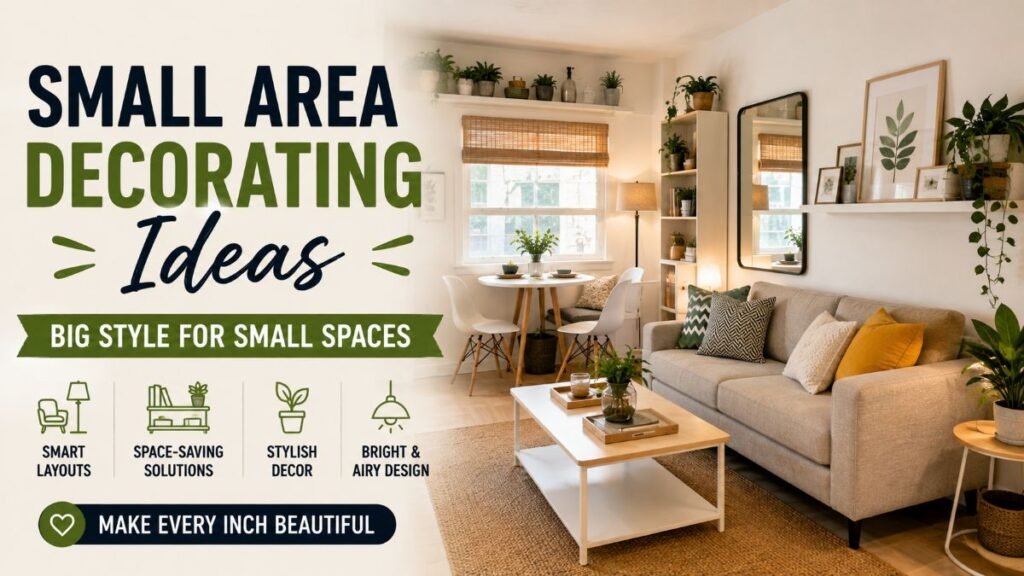
A small room doesn’t have to feel like a room where everything has been squeezed into place. The real challenge is usually not the number of square feet—it is what you do with them. A bulky sofa, crowded walls, poor lighting, or furniture that blocks the walking path can make a compact space feel even smaller. The right small area decorating ideas work differently: they give each piece a purpose, create breathing room, and make the room feel considered rather than crowded.
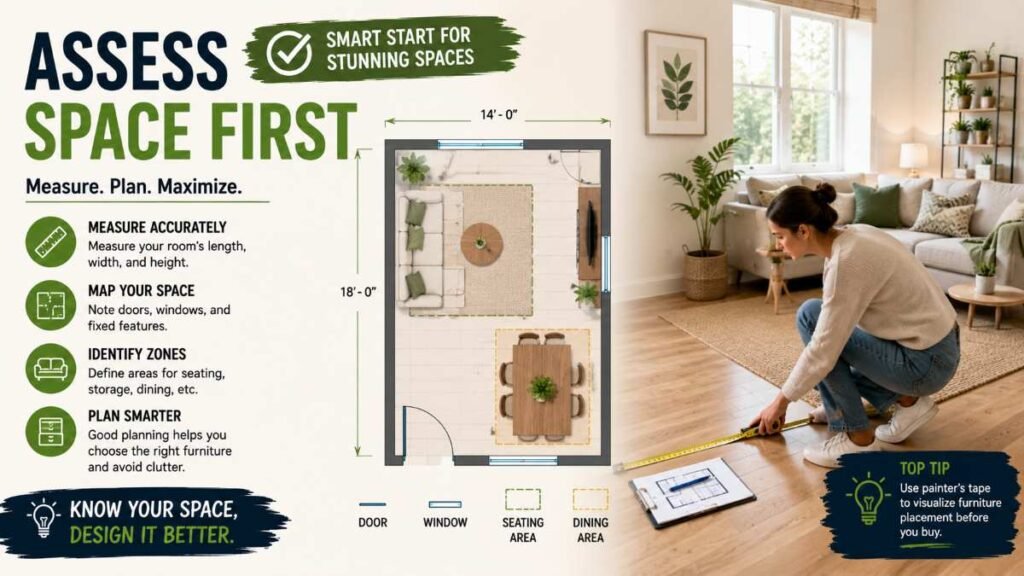
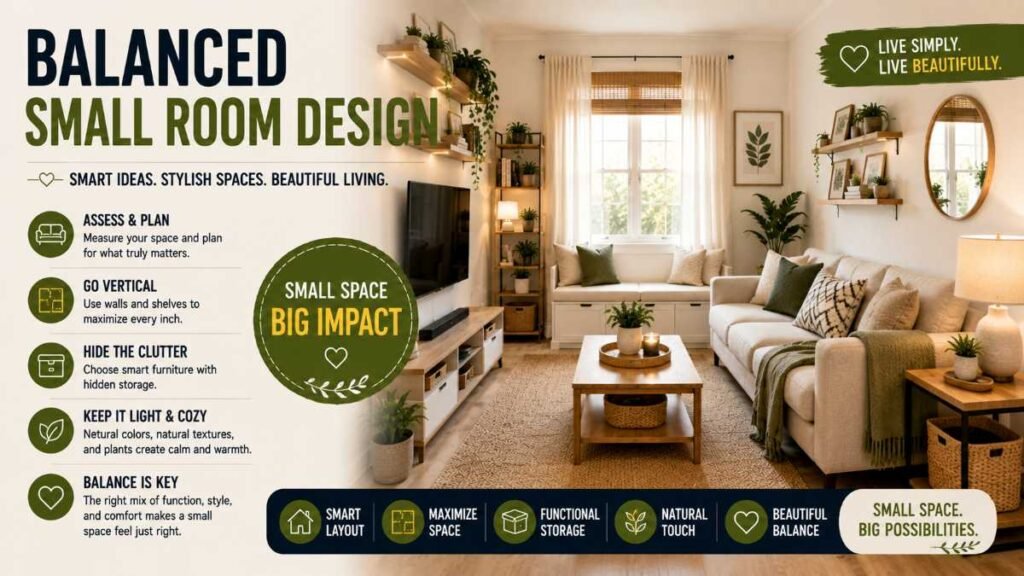
Assess Your Space First
Before buying another decorative piece, step back and look at the room as a whole.
Where do people naturally walk? Which areas feel crowded? Is there unused wall space? Does furniture block a window or doorway?
This simple assessment can prevent one of the most common small-space mistakes: buying attractive pieces individually without considering how they work together.
A good decorating plan should account for:
- Furniture size and placement
- Walking paths
- Natural light
- Storage needs
- Wall space
- Existing colors and materials
- How the room is actually used
Good small-space design starts with proportion and circulation rather than simply adding more decor. Architectural Digest’s small-space decorating guidance also highlights furniture placement, clear floor space, lighting, and choosing pieces that earn their place.
A quick planning rule
Before adding something new, think about whether the room really needs it:
Where will it go? What will it replace? What job does it perform?
If the answer to the third question is simply “it looks nice,” that’s fine occasionally. But in a small room, decorative pieces need to earn their space more often than they would in a large one.
Choose Furniture That Works Harder
One of the smartest small area decorating ideas is to stop thinking of furniture as having only one purpose.
Before adding something new, think about whether the room really needs it. A narrow console can serve as an entry table while providing a surface for baskets underneath. A bench can work near an entryway and double as extra seating when guests arrive.
Multifunctional furniture is particularly useful in apartments, studios, guest rooms, and compact living rooms.
Furniture | Possible Second Job |
Storage ottoman | Seating + hidden storage |
Bench | Seating + entryway surface |
Drop-leaf table | Dining + workspace |
Storage bed | Sleeping + clothing storage |
Narrow console | Display + organization |
Folding desk | Workspace + open floor area |
The goal isn’t to fill the room with clever furniture.
It’s actually the opposite.
Fewer useful pieces can often work better than many small pieces.
Use the Walls Instead of Crowding the Floor
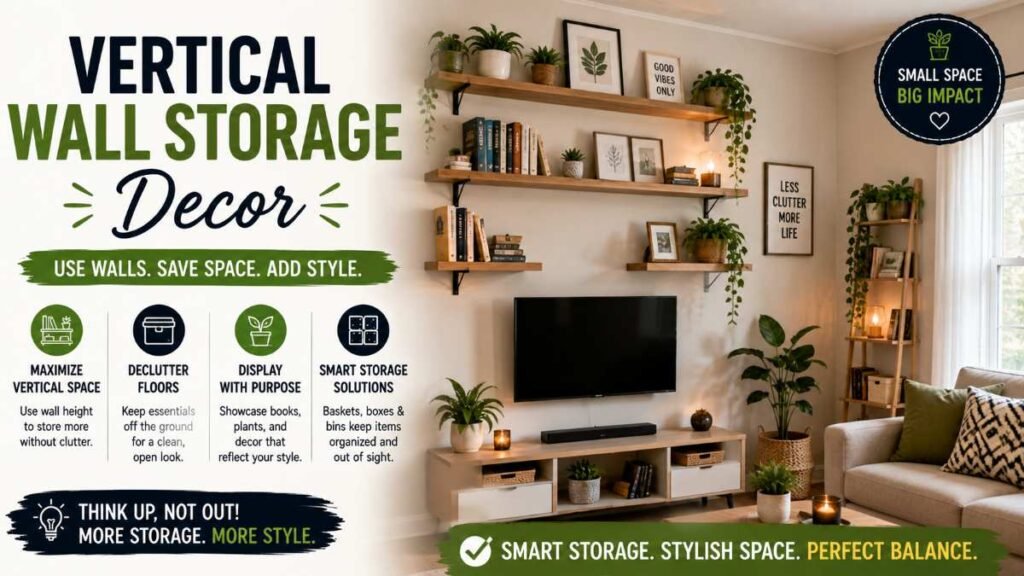
When floor space is limited, look upward.
Wall-mounted shelves, floating nightstands, hooks, slim cabinets, and vertical bookcases can move useful functions away from the floor.
This has two benefits: you gain storage or display space, and more of the floor remains visually open.
A narrow room can especially benefit from vertical storage because tall elements draw attention upward rather than spreading furniture across the room.
Recent Architectural Digest vertical-design guidance also emphasizes using walls and other vertical areas for storage, lighting, and artwork when floor space is limited.
Try:
- Floating shelves
- Wall-mounted lighting
- Tall bookcases
- Peg rails
- Vertical artwork
- Narrow cabinets
- Hooks behind doors
If you’re decorating a small bedroom or wardrobe area, your existing small closet organization ideas can help you think about storage beyond traditional furniture.
Don’t fill every inch of wall
There is a temptation to treat empty wall space as wasted space.
It isn’t.
A little breathing room around artwork, shelving, or furniture can make the entire arrangement feel calmer.
Let Mirrors and Light Do Some of the Visual Work
A mirror cannot physically add square footage, but it can change how a room feels.
Positioning a mirror where it can reflect daylight or a pleasant part of the room can help create a brighter, more open visual effect. Architectural Digest’s small-space mirror and lighting advice similarly recommends using mirrors to reflect available light and visually expand a compact room.
Lighting deserves the same attention.
Instead of relying entirely on one overhead fixture, consider layering:
Layered Lighting for a More Comfortable Room
For example:
- Ceiling fixture for general illumination
- Table lamp for reading
- Wall sconce for a darker corner
- Small accent lamp for warmth
This makes a compact room feel more intentional at night.
And if you’re working on a smart home setup, your existing smart home automation guide can help you explore ways to manage lighting more conveniently.
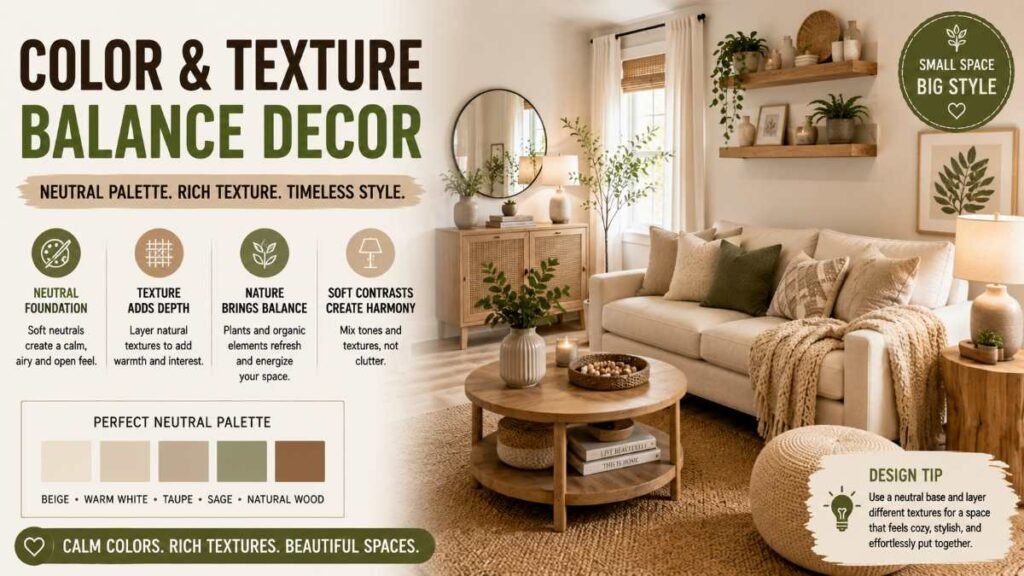
Make a Small Room Feel Bigger With Color and Texture
White walls are not the only answer.
A small room can work beautifully with warm neutrals, muted greens, soft blues, earthy tones, or even a deeper color when used thoughtfully.
The key is cohesion.
If every wall, furniture piece, rug, and accessory introduces a completely different color, the room can become visually noisy.
Instead, choose a simple palette:
Base | Supporting Color | Accent |
Warm white | Beige | Olive |
Soft gray | Cream | Navy |
Sand | Warm brown | Terracotta |
Pale blue | White | Natural wood |
Texture can add interest without requiring more objects.
Think:
- Linen
- Wood
- Woven baskets
- Cotton
- Wool
- Matte ceramics
- Soft upholstery
And don’t assume a small room has to be completely white or stripped of personality. Current small-space design advice increasingly focuses on visual weight, proportion, and editing, rather than following one rigid color rule.
Don't Automatically Buy Tiny Furniture
This sounds counterintuitive, but small space does not always mean tiny furniture.
A room filled with miniature chairs, narrow tables, tiny artwork, and several little storage pieces can actually look more cluttered.
Instead, consider one or two appropriately scaled pieces and eliminate unnecessary extras.
For example, a compact living room may work better with:
One comfortable sofa + one useful coffee table + one substantial rug
than:
Two tiny chairs + tiny sofa + multiple side tables + several decorative stools.
Proportion matters.
Recent designer guidance featured by Architectural Digest also challenges the assumption that every small room needs miniature furniture, emphasizing appropriate scale and visual weight instead.
Before buying furniture, measure both the piece and the room.
That five-minute measurement can save you from a very expensive mistake.
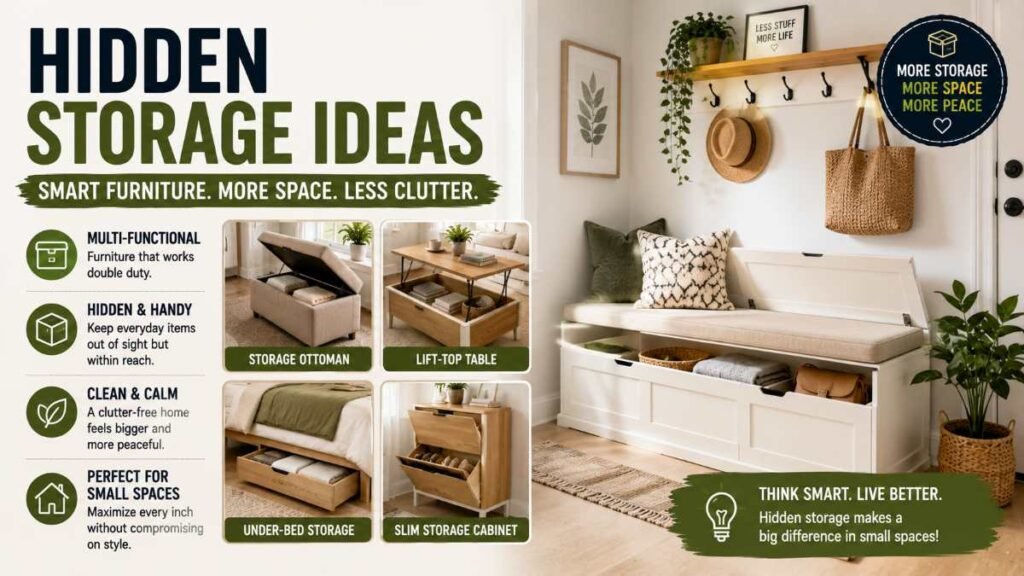
Create Storage Without Making the Room Look Like Storage
Storage is essential in a small home, but visible clutter can quickly become the dominant feature.
The trick is to give everyday items designated homes.
Use:
- Baskets under consoles
- Closed cabinets
- Drawer organizers
- Storage benches
- Bed drawers
- Over-door organizers
- Matching containers
Open shelving can look beautiful, but it works best when the items displayed are intentionally edited.
If every shelf becomes a place to put something, the room starts to feel busy.
For areas where storage is especially difficult, SmartHome Zenith’s laundry room storage ideas and smart garage storage ideas offer related organization concepts that can be adapted to other parts of the home.
8Use Rugs, Curtains, and Artwork Strategically
Soft furnishings can make a small space feel finished—but the wrong scale can work against you.
A rug that’s too small can visually break up the floor and make the room feel disconnected. Architectural Digest’s small-space decorating guidance specifically recommends choosing a rug with enough coverage rather than defaulting to a tiny rug.
Likewise, curtains mounted close to the ceiling and extending toward the floor can create a stronger vertical line than short curtains that stop immediately around the window.
Artwork should also have a purpose.
Instead of covering every available wall with small frames, consider one larger piece or a carefully arranged grouping.
The goal is not maximum decoration.
It is visual confidence.
One strong element often has more impact than ten unrelated accessories.
Give Every Corner a Job
A forgotten corner doesn’t necessarily need another chair.
Ask what the space is missing.
A small corner could become:
- A reading spot
- A compact home office
- A plant display
- A coffee station
- A drop zone
- A storage area
- A small vanity
- A display shelf
For example, an awkward corner beside a window might need nothing more than a slim chair, small table, and lamp.
A narrow entryway might benefit from hooks, a floating shelf, and a small bench.
The best small area decorating ideas often begin by identifying an unused function rather than shopping for decoration first.
Avoid the Small-Space Decorating Mistakes That Add Clutter
Sometimes the easiest way to improve a small room is to remove something.
Watch for these common problems:
Mistake | Better Approach |
Too many small furniture pieces | Choose fewer, better-scaled pieces |
Blocked walking paths | Create a clear circulation route |
Too many colors | Use a controlled palette |
Tiny rugs | Choose a rug with appropriate coverage |
Every wall filled | Leave intentional breathing room |
Open shelves packed tightly | Edit what is displayed |
Furniture covering windows | Protect natural light |
No hidden storage | Use multifunctional pieces |
The important distinction is that decluttering isn’t the same as making a room boring.
You can have personality without having visual overload.
A Simple Small-Space Decorating Plan
If you’re not sure where to begin, don’t try to change everything in one weekend.
Use this sequence:
Step | What to Do |
1 | Remove items you no longer use |
2 | Measure the room |
3 | Identify the main function |
4 | Fix the furniture layout |
5 | Add useful storage |
6 | Improve lighting |
7 | Add one mirror or strong artwork |
8 | Introduce texture |
9 | Edit accessories |
10 | Live with the room before buying more |
That final step is surprisingly valuable.
Spend a few days in the room.
You may discover that the corner you thought needed a cabinet actually needs better lighting—or that the extra side table you were planning to buy isn’t necessary at all.
Final Takeaway
The best small area decorating ideas aren’t about making a compact room look like a large one.
They’re about making the space work beautifully at the size it actually is.
Choose furniture carefully. Keep walking paths open. Use vertical space. Let mirrors and lighting add visual depth. Give storage a proper home, and don’t be afraid to leave some areas empty.
Most importantly, decorate with intention.
A small room doesn’t need more stuff to feel finished. It needs the right stuff, in the right place, with enough breathing room around it.
People also ask
Q1: What are the best design tricks for small spaces? Use vertical shelves, mirrors, and dual-purpose furniture while keeping 36-inch clear walkways for smart small area decorating ideas.
Q2: What is the 3-5-7 rule in decorating? It uses odd-numbered item clusters (3, 5, or 7) like books or vases to give small area decorating ideas a natural, balanced look.
Q3: What are some good decorating ideas for small spaces? Pick well-scaled furniture, layered lighting, and hidden storage benches—key small area decorating ideas to cut visual clutter.
Q4: What are some creative ways to decorate a narrow space? Shift sofas 2 feet off walls, hang full-length drapes, and use vertical art as high-impact small area decorating ideas.
Author By: Dambar C. Rajbanshi About: A renovation strategist and home improvement enthusiast. Dambar specializes in budget-smart planning and functional kitchen design. He is dedicated to helping homeowners create spaces that perfectly balance beauty and practicality