
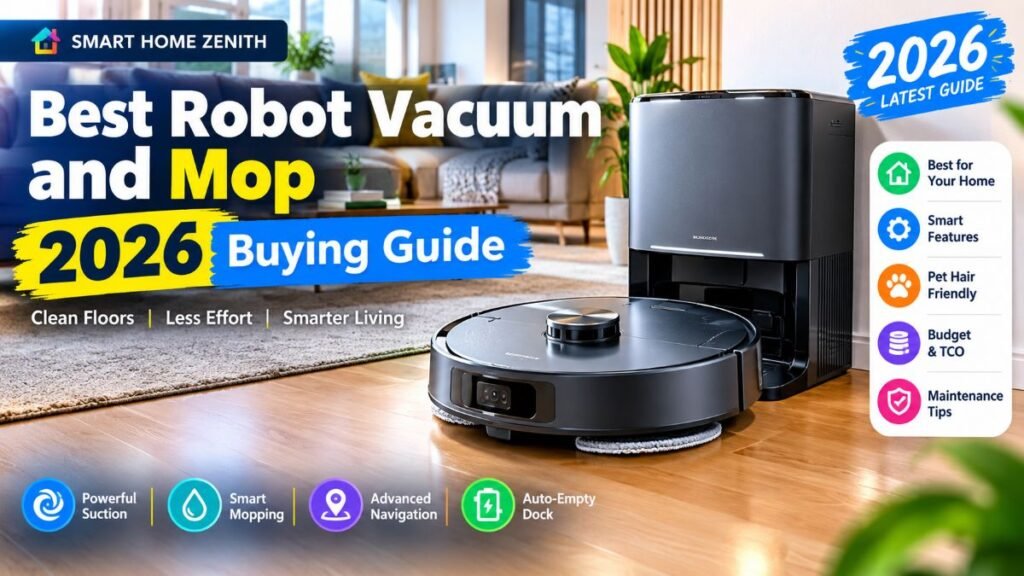
Stepping onto your floors after a 10-hour workday should mean feeling clean, grit-free surfaces underfoot—not sticky spills or tumbling pet hair. Yet choosing the wrong automated floor cleaner can leave you with an expensive appliance that requires more supervision than expected. Here is how to select the best robot vacuum and mop tailored precisely to your floor plan, budget, and lifestyle.
Quick Buying Checklist
- ☐ Flooring Ratio: Measure your hardwood vs. carpet percentage before shopping.
- ☐ Carpet Clearance: Check the manufacturer’s stated mop-lifting height to confirm it clears your specific rugs.
- ☐ Pet Hair Level: Prioritize anti-tangle rubber rollers over traditional bristle brushes.
- ☐ Dock Footprint: As a practical planning guideline, allow roughly 1.5 ft clearance on the sides and 3 ft in front, unless the manufacturer specifies different requirements.
- ☐ Maintenance Tolerance: Choose an auto-empty dock if weekly manual maintenance is a dealbreaker.
- ☐ Consumables Budget: Factor in replacement filters, dust bags, and mop pads ($50–$100/year rough estimate).
The Real Evolution: How Automated Floor Care Works
Early hybrid floor sweepers dragged a cold, damp cloth behind a low-powered suction inlet. Modern dual-action floor cleaners combine active scrubbing, high-velocity airflow, and automated water management.
System Component | What It Means | Who Needs It |
LiDAR + AI Sensors | Prevents stuck cycles and cord wrapping | Homes with toys, cables, or tight clutter |
High-Velocity Airflow | Pulls fine dust out of cracks and carpet fibers | Homes with deep tile grout or thick carpets |
Active Scrubbing | Cleans dried liquid spills instead of wiping over them | Kitchens and dining areas prone to food spots |
All-in-One Omni Base | Reduces how often you need to manually maintain the dock | Busy homeowners seeking minimal maintenance |
Integrating an automated floor cleaner keeps walkways clean daily without requiring physical labor every evening. For broader smart home upgrades, explore our smart home automation guide.
Navigational Intelligence: LiDAR vs. Optical AI
Choosing the best robot vacuum and mop depends on how effectively a machine maps your layout and reacts to everyday obstacles.
Tech Category | Built-in Hardware | Key Benefit | Main Drawback |
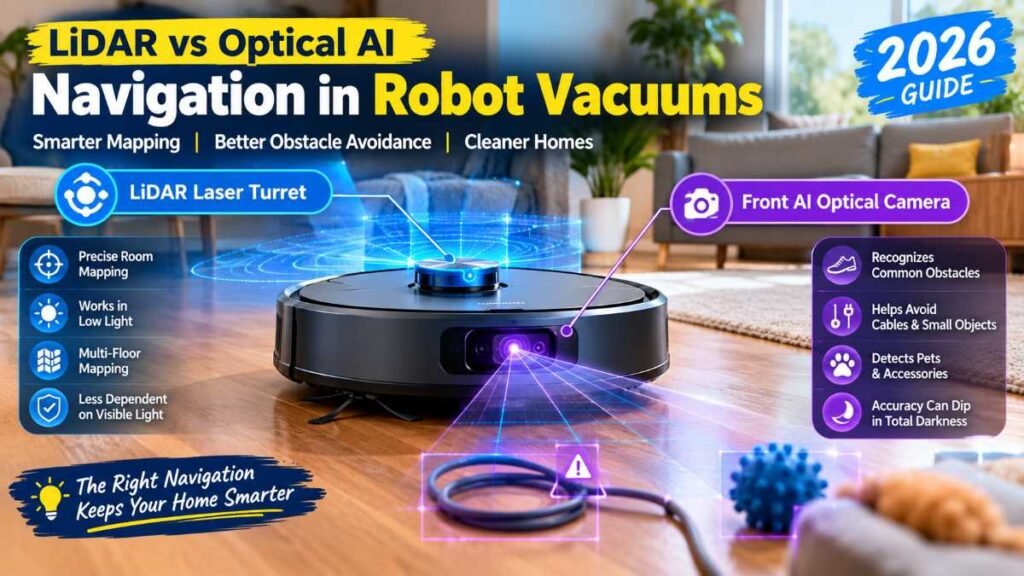
LiDAR Laser Mapping | Continuous 360-degree laser sensor | Builds layout maps quickly and operates in unlit or dimly lit spaces | Easily misses small floor hazards like chargers, stray socks, or flat toys |
Camera-Based AI Vision | Front-mounted RGB camera and light sensors | Steers clear of unexpected household items left lying on the floor | Needs adequate room lighting to identify and bypass small obstacles |
Hybrid Dual Navigation | Laser turret merged with optical vision | Combines whole-house mapping with active hazard avoidance for smooth cleaning | Comes with a premium price tag usually limited to high-end models |
- LiDAR Mapping Capabilities: LiDAR-based mapping is generally less dependent on visible light than camera-based navigation, mapping walls and furniture reliably even in dark rooms.
- AI Optical Vision Systems: Advanced models use front-facing optical cameras combined with machine vision to steer around charging cables, stray socks, or pet accessories.
Representative Market Model Classes
To help you choose the best robot vacuum and mop, here is how representative market model classes align across specifications:
Model Class | Engineering Focus | Navigation | Mopping System | Mop Clearance | Dock Features | Main Limitation |
Roborock S8 MaxV Ultra Class | Maximum Automation | Hybrid LiDAR + AI | Dual-Spinning / Sonic Mop | Up to 20 mm* | Hot-Water Wash & Heated Air | Higher initial price point |
Dreame L20 Ultra Class | Edge-to-Edge Mopping | LiDAR + Optical | Extendable Mop Arms | Automatic Mop Removal for Carpets | Auto-Empty & Fluid Refill | Large base station footprint |
Ecovacs Deebot X2 Omni Class | Low-Profile Access | Dual-Laser LiDAR | Dual Counter-Rotating Pads | Auto Mop Lift (15 mm) | Hot Water Clean & Air Dry | Square body shape navigation quirks |
iRobot Flagship Combo Category | Specialized Thick Rug Protection | AI-Powered Visual Sensor Navigation I | Lifting Mop Assembly with Top Storage | Elevates Entirely Above Chassis | Automatic Bin Emptying and Water Reservoir Filling | Docking Unit Lacks Heated Air Drying Mechanism |
*Specification note: Manufacturer-stated figure; actual carpet compatibility can vary by rug thickness and surface. Product features can vary by region, retailer SKU, firmware version, and product revision. Always confirm current specifications on the official product page.
Real-World Buyer Scenarios
- Scenario 1: Apartment with Hardwood Floors
- Prioritize: Precise water control, compact dock footprint, and soft rubber rollers. Learn more about floor care in our kitchen flooring guide.
- Avoid: Overpaying for ultra-high carpet lifting clearance.
- Scenario 2: Multi-Room Family Home with Mixed Flooring
- Prioritize: Hybrid LiDAR + AI navigation, automatic mop lifting, and multi-floor mapping.
- Avoid: Static mop plate models that drag damp pads over carpeted rooms.
- Scenario 3: Pet Owners with Carpets
- Prioritize: Anti-tangle dual rubber rollers, high airflow velocity, and self-emptying dust docks.
- Avoid: Traditional bristle brushes that trap pet fur around bearings.
- Scenario 4: Busy Households with Kitchen Spills
- Prioritize: Dual spinning pads or continuous roller mops, warm-water dock washing, and heated-air pad drying.
- Avoid: Basic dry-sweeping hybrid units without active scrubbing.
Floor Surface Decision Matrix
Home Setup | Priority Features | Recommended Focus |
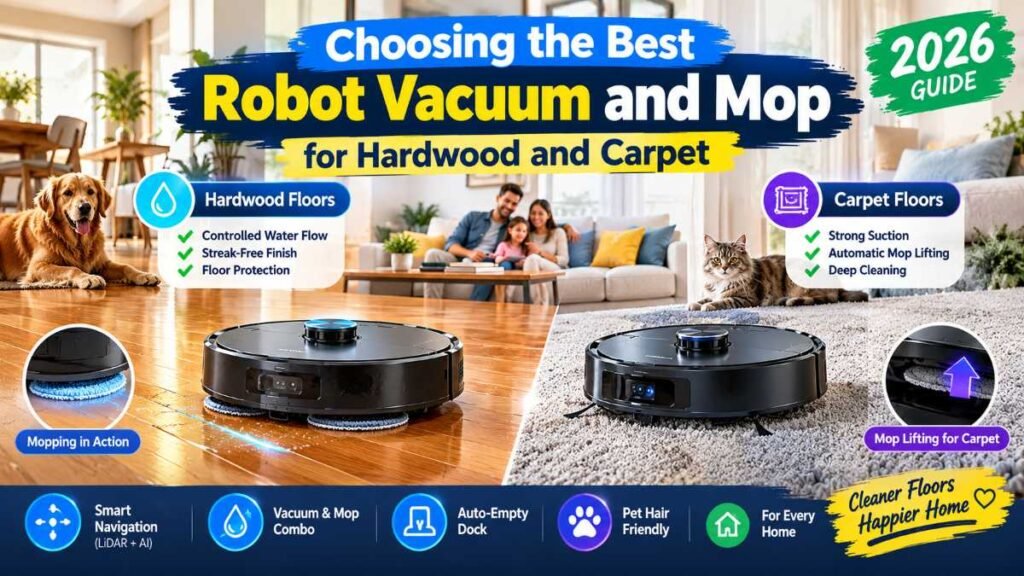
Mostly Hardwood | Controlled water flow + floor protection | Precise liquid management + microfiber pads |
Thick Carpets | Carpet detection + high airflow | Automatic mop lifting or mop detachment |
Heavy Pet Hair | Anti-tangle rollers + sealed dust bag | Dual rubber brush rolls + auto-empty dock |
Tile & Grout Lines | Active downward scrubbing + precise border sweeping | Dual rotating mop discs + adaptive edge-cleaning side brushes |
Mixed Flooring | Auto carpet detection + smart navigation | Hybrid LiDAR + dynamic pad elevation |
Why Suction Ratings Can Be Misleading
A high suction rating does not guarantee superior cleaning. Real-world performance depends on multiple engineering factors:
- Brush Roll Geometry: Dual counter-rotating rubber rollers channel debris better than single bristle rollers.
- Sealed Airflow Path: A tightly sealed vacuum path maintains constant suction lift without power leaks.
- Carpet Detection Response: Rapid sensor-driven power boosts on rugs yield better dander removal than raw static suction numbers.
- Active Agitation: Downward scrubbing pressure matters far more for liquid stain removal than raw vacuum suction.
Category Advantages & Limitations
System Advantages
- Automated Daily Upkeep: Helps keep everyday dust, dander, and floor grit under control.
- Time Savings: Reduces manual vacuuming and mopping chores significantly.
- Smart Scheduling: Integrates with daily routines, similar to adding other best smart home devices.
System Limitations
- Maintenance Requirements: Docks, filters, brushes, and wash trays still require periodic cleaning.
- Obstacle Handling Limits: Stray phone cords, light throw rugs, and deep carpet tassels can cause stalls.
- Inherent Physical Boundaries: Robots cannot clean stairs, remove deep dried paint/syrups, or navigate heavy floor clutter.
Budget Guidance & Total Ownership Cost
Price ranges vary by retailer, current sales, and regional model updates:
- Entry Tier ($250 – $450): Basic LiDAR or bump navigation, static mop plate, standard charging dock.
- Mid-Range Tier ($500 – $850): Precise LiDAR mapping, basic obstacle avoidance, auto-empty dust dock, mop pad lifting.
- Premium Flagship Tier ($900 – $1,500+): Hybrid LiDAR + AI optical navigation, fully automated omni-dock.
Total Cost of Ownership (TCO)
As a rough planning estimate, expect to spend $50 – $100 annually on replaceable consumables. Actual costs vary by model, usage, and replacement schedule:
- Dust Bags: Replace every 30–60 days ($15–$25/pack).
- HEPA Filters: Replace every 3–6 months ($10–$20/pack).
- Brush Rolls & Mop Pads: Replace every 6–12 months ($15–$30).
- Approved Cleaning Solution: Non-foamy floor cleaner ($15–$25/bottle).
Safety, Care, and Maintenance Guidelines
- Placement Safety: Place the charging dock on a level surface near a grounded outlet away from direct water splash zones.
- Cable Management: Secure loose cords to reduce the risk of tangling, cable damage, or the robot pulling connected devices.
- Official Care: Use manufacturer-approved non-corrosive floor solutions to avoid damaging internal pump seals.
For official appliance safety guidance and energy standards, consult trusted U.S. consumer resources:
- Review appliance safety standards at the U.S. Consumer Product Safety Commission (CPSC).
- Check energy guidelines via the official ENERGY STAR Program.
- Read indoor air quality guidance from the U.S. Environmental Protection Agency (EPA).
Maintenance Schedule
Frequency | Target Component | Action Required |
After Run / Daily | Water Tanks | Empty dirty water tank; refill clean water tank |
Weekly | Sensors & Contacts | Gently wipe lenses and charging contacts with a dry microfiber cloth |
Bi-Monthly | Primary Roller Assemblies | Clear tangled hair from side caps and bearing joints |
Monthly | Base Station Basin | Remove wash tray and rinse accumulated sediment under warm water |
Practical Troubleshooting
Problem | Possible Cause | Action Required |
Robot Won’t Dock | Blocked dock path / dirty contacts | Clear 3 ft radius around dock; clean metallic charging contacts |
Leaves Floor Streaks | Dirty mop pads / incorrect fluid ratio | Wash mop pads; reduce app water flow settings |
Repeated Navigation Jams | Smudged LiDAR lens / loose cables | Wipe top laser tower and front camera; tidy loose floor cords |
Decreased Suction | Full dust bag / clogged filter | Replace dock dust bag; inspect internal filter for blockages |
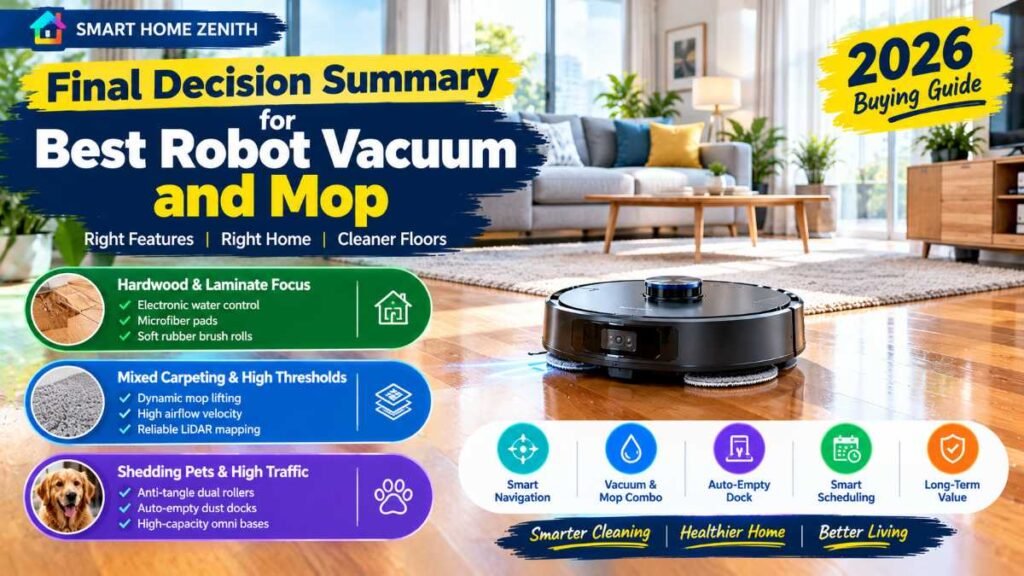
Decision Summary
Finding the best robot vacuum and mop comes down to matching hardware capabilities with your living space:
- Hardwood & Laminate Focus: Prioritize precise electronic water regulation, microfiber pad control, and soft rubber brush rolls.
- Mixed Carpeting & High Thresholds: Prioritize dynamic mop lifting, high airflow velocity, and reliable LiDAR mapping.
- Shedding Pets & High Traffic: Prioritize anti-tangle dual rubber rollers, auto-empty dust docks, and high-capacity omni bases.
Assess your floor layout, establish your budget including consumable TCO, select the navigation tier that fits your clutter levels, and enjoy clean floors every day. For overall home maintenance tips, check out our smart home buying guide.
Frequently Asked Questions
Q1. Which robot vacuum with mop is the best?
The best robot vacuum and mop for automation is the Roborock S8 MaxV Ultra, while the Dreame L20 Ultra dominates edge-to-edge scrubbing.
Q2. Is it worth getting a robot vacuum that mops?
Yes. The best robot vacuum and mop combos scrub sticky spills and auto-lift pads over carpets for truly hands-off floor care.
Q3. Is Ecovacs better than Roborock?
It depends on your space. Roborock delivers smarter AI navigation, while Ecovacs offers stronger downward scrubbing power for tough stains.
Q4. Which robot vacuum brand is better, Roborock or Dreame?
Both offer top-tier tech—Dreame features extendable mop arms for corners, while Roborock leads as the best robot vacuum and mop brand for dock automation.
Q5. What is the top performing robot vacuum and mop for pet owners?
The best robot vacuum and mop for pets uses anti-tangle dual rubber brushes and an auto-empty dock to prevent hair clogs.
Editorial Disclaimer:
Product evaluations are based on official manufacturer documentation, technical whitepapers, and safety guidelines. We maintain transparent research methodology without false hands-on testing claims.
About the Author & Editorial Standards
Written by: Dambar C.Rajbanshi | Reviewed by: Smart Home Zenith Editorial Team