
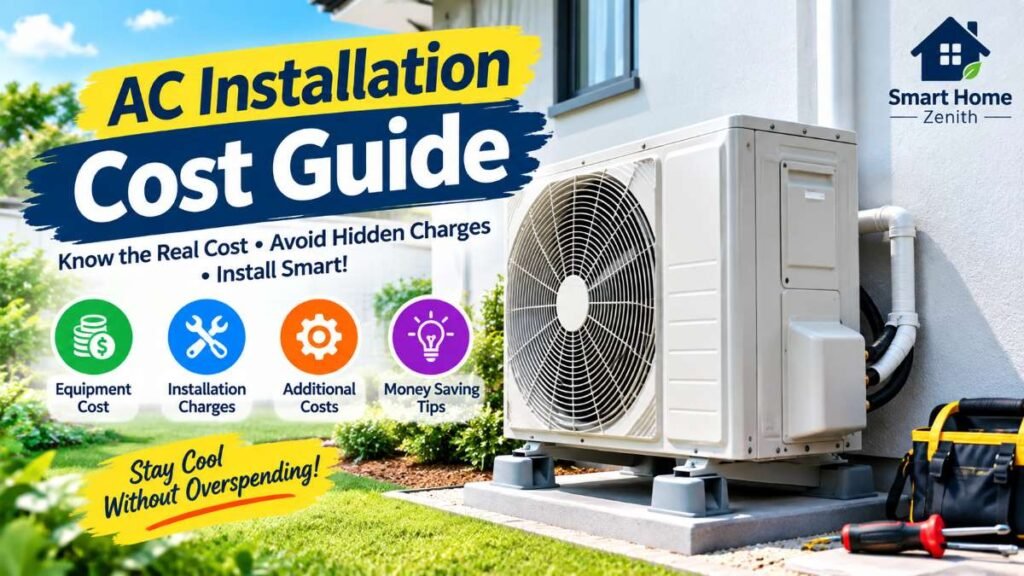
A sudden summer air conditioner breakdown can freeze your budget in seconds. Across the U.S., an unexpected ac installation cost swings wildly from $3,800 to over $12,000 depending on your home’s hidden specs. Why do two identical houses on the same block get radically different contractor quotes? Before signing an expensive proposal, uncover the exact efficiency ratings, hidden line items, and regional labor factors that control your final invoice
Sizing Your System: Why Proper Capacity Demands a Manual J Calculation
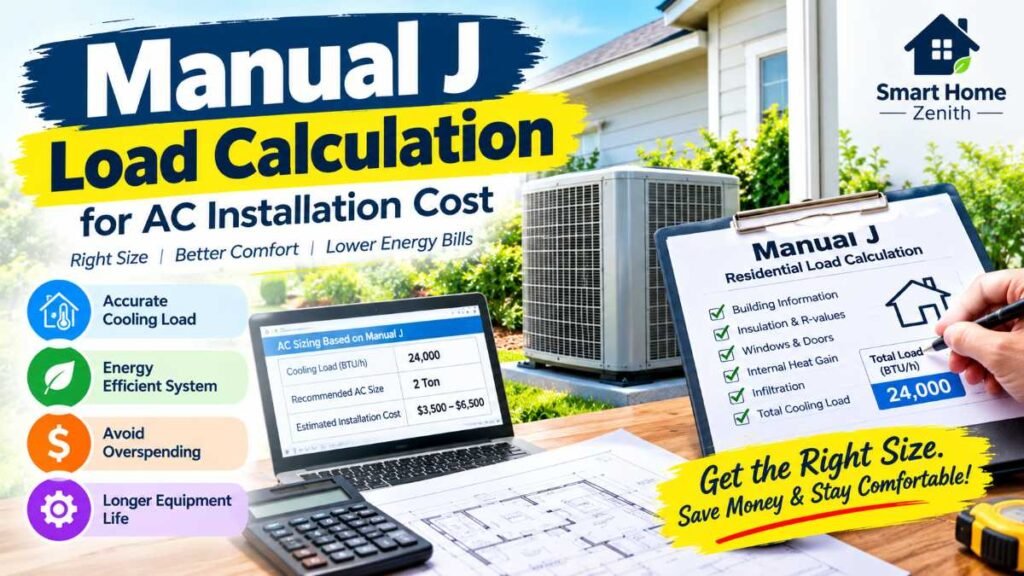
Installing a central air conditioner should always be guided by a professional Manual J load calculation rather than a generic square-foot estimate.
Relying strictly on living area square footage often leads to improper equipment sizing. Modern HVAC engineering accounts for multiple structural and environmental variables to determine cooling loads accurately:
FACTORS IN A PROFESSIONAL MANUAL J Calculation
│ • Local Outdoor Climate & Peak Summer Temperatures │
│ • Total Living Area & Ceiling Volume │
│ • Insulation R-Values (Attic, Exterior Walls, Floor) │
│ • Window Quantity, Orientation & Solar Heat Gain │
│ • Existing Duct Air Leakage & Air Infiltration Rates
An oversized air conditioner cools indoor air too quickly without running long enough to remove ambient humidity, leaving your living space feeling cold and clammy. An undersized unit runs continuously during severe heatwaves, spiking utility bills without maintaining setpoint temperatures.
Labor and permit charges typically represent 40% to 55% of your total contractor invoice. Difficult attic line runs, electrical subpanel expansions, or outdoor pad grading directly increase active installation hours.
Average Installation Costs by System Type
The table below outlines average equipment, labor, and total project investment ranges across major residential cooling configurations in the United States.
System Configuration | Equipment Cost Range | Labor & Installation | Estimated Total Cost | Average Lifespan |
Central AC (Standard 13.8–15.2 SEER2) | $1,800 – $3,400 | $2,000 – $3,800 | $3,800 – $7,200 | 15 – 20 Years |
Central AC (High-Eff. 16–21+ SEER2) | $3,200 – $6,500 | $2,700 – $5,500 | $5,900 – $12,000 | 15 – 20 Years |
Ductless Mini-Split (Single Zone) | $1,200 – $2,500 | $1,300 – $2,500 | $2,500 – $5,000 | 15 – 20 Years |
Ductless Mini-Split (Multi-Zone 3–4 Heads) | $3,800 – $7,500 | $3,200 – $6,500 | $7,000 – $14,000 | 15 – 20 Years |
Geothermal Heat Pump Cooling | $8,000 – $16,000 | $7,000 – $14,000 | $15,000 – $30,000+ | 20 – 25+ Years |
Note: Figures represent estimated installed project ranges across average U.S. single-family homes. Final quotes vary based on geographic region, home accessibility, local permit mandates, ductwork condition, and required electrical modifications.
Cost Breakdown: SEER2 Ratings and Compressor Types
Equipment selection, seasonal efficiency ratings, and compressor mechanics determine initial purchasing costs and monthly power consumption.
Efficiency Level | Estimated Installed Cost Range | Primary Characteristics | Best Fit Applications |
Baseline SEER2 (13.8–15.2) | $3,800 – $7,200 | Single-stage compressor; operates at 100% capacity whenever active. | Moderate summer climates, budget-conscious replacements, or rental properties. |
Mid-Tier SEER2 (15.5–18.0) | $5,500 – $9,200 | Two-stage compressor; runs at high/low capacity for improved humidity control. | Regions with extended hot summers and homeowners seeking balanced efficiency. |
Premium SEER2 (18.5–24.0+) | $8,000 – $13,500+ | Variable-speed/inverter compressor; adjusts cooling output in tiny increments. | Deep Sunbelt regions, maximum home comfort, and long-term energy savings targets. |
Single-Stage vs. Variable-Speed Compressors
Single-stage systems cycle fully on or off. While their initial upfront ac installation cost remains lower, frequent cycling increases mechanical wear and creates temperature swings between cooling cycles.
Variable-speed (inverter-driven) systems operate continuously at reduced power levels to maintain steady indoor temperatures. Pairing high-efficiency cooling infrastructure alongside envelope upgrades like an energy efficient window installation maximizes total household energy conservation.
Electrical and Smart System Integration
Central air conditioners require dedicated 240V double-pole circuit breakers and heavy-gauge wiring. Ensure your main service panel is adequately protected—similar to standards required when installing a whole house surge protector—to shield sensitive inverter control boards from lightning or grid surges. Connecting high-efficiency systems to modern best smart thermostats options provides precise temperature scheduling and remote system monitoring.
Hidden Line Items in HVAC Proposals
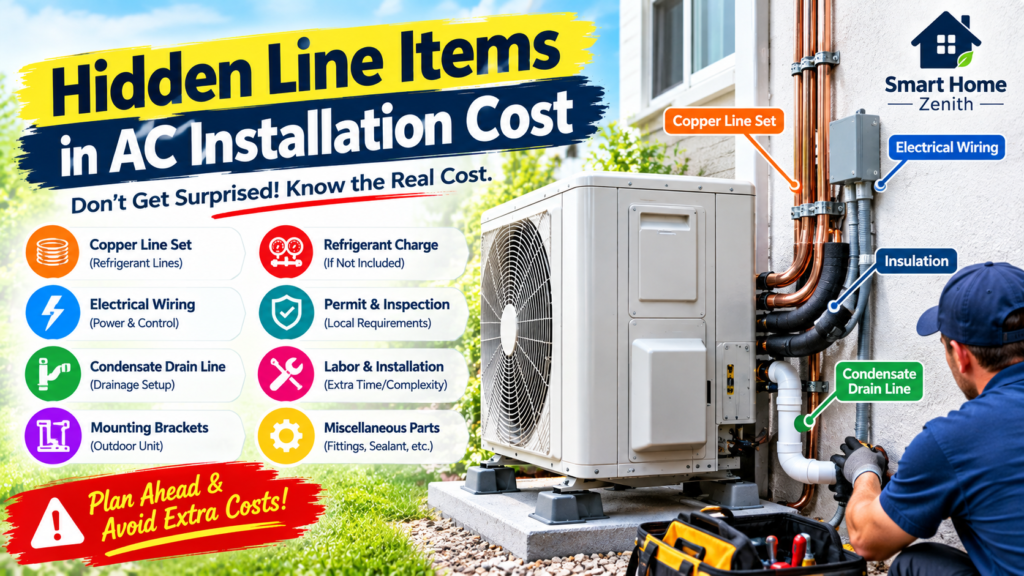
To avoid unexpected extra charges on your final invoice, check that your contractor’s quote explicitly includes these necessary infrastructure components:
- Old System Teardown & Haul-Away ($200 – $500): Covers EPA-mandated refrigerant recovery, disconnecting old equipment, and eco-friendly scrap recycling fees.
- Ductwork Modifications or Replacement ($800 – $3,500): Retaining existing ductwork requires checking for proper sizing, static pressure limits, and air leaks. Proper attic and crawlspace sealing helps maintain air quality, much like completing structural updates detailed in a basement waterproofing guide.
- Refrigerant Line Set Replacement ($400 – $1,200): Running new copper lines between indoor evaporator coils and outdoor condenser units ensures system longevity and prevents contamination.
- Electrical Panel Upgrades or Disconnect Box ($350 – $1,100): Installing dedicated exterior disconnect switches or upgrading older subpanels to meet municipal electrical codes.
Condensate Drain Lines & Safety Switches ($150 – $400): Installing primary condensate lines, secondary overflow pans, and float switches to prevent water damage to ceilings below.
Regional Price Trends Across North America
Local labor rates, municipal permit standards, and regional climate demands shape overall project proposals across the United States:
- Sunbelt & Southern States (TX, FL, AZ, GA): $6,200 – $13,000 baseline. Long, blistering summers require high-capacity, high-SEER2 equipment and heavy-duty dehumidification. Continuous summer operation requires higher SEER2 ratings, robust dehumidification, and larger tonnage units.
- Mid-Atlantic & Midwest (OH, PA, IL, MO): $4,800 – $9,500 base average. Moderate summer cooling seasons allow for balanced mid-tier equipment choices and lower labor costs.
- Pacific Northwest & Northeast (WA, OR, NY, ME): $5,200 – $11,000 base average. Higher local labor rates, strict municipal permitting, and growing demand for ductless mini-splits drive regional quotes.
Financial Incentives and Budget Optimization Strategies
Available federal tax credits, state energy programs, utility rebates, and manufacturer promotions change over time. Homeowners should verify current eligibility through the Internal Revenue Service (IRS) and local utility providers before factoring financial incentives into project budgets.
Comparing itemized bids helps homeowners evaluate complete system value and manage total ac installation cost:
- Gather Itemized Estimates: Require written proposals breaking down equipment model numbers, SEER2 ratings, refrigerant line work, permit costs, and labor hours.
- Record Existing System Data: Note your current unit’s tonnage, model number, electrical service size, and ductwork condition before scheduling contractor estimates.
- Check Off-Season Scheduling: Inquire about late winter or early spring installation dates when HVAC contractors typically offer off-peak pricing discounts.
7. Homeowner Inspection & Contractor Checklist
Before signing an installation agreement, use this practical checklist to review your contractor’s proposal:
┌───────────────────────────────────────────────────────────────────┐
│ AIR CONDITIONER CONTRACTOR CHECKLIST │
├───────────────────────────────────────────────────────────────────┤
│ [ ] Exact Outdoor & Indoor Unit Model Numbers Listed │
│ [ ] AHRI Certificate & SEER2 Rating Confirmed │
│ [ ] Formal Manual J Cooling Load Calculation Performed │
│ [ ] All Installation Labor & Equipment Included │
│ [ ] Municipal Permits & Local Inspection Fees Detailed │
│ [ ] Old Equipment Removal & EPA Refrigerant Recovery Included │
│ [ ] New Copper Line Set & Electrical Disconnect Specified │
│ [ ] Verified Workmanship & Factory Coverage: Full written documentation for both installer labor protection and brand-level unit warranties│
│ [ Written Equipment & Labor Guarantees: Ensures both brand-backed unit protection and contractor service warranties are explicitly documented.│
Frequently Asked Questions
Q1: What is the $5000 rule for AC?
It’s a guide: multiply your unit’s age by its repair quote. If it exceeds $5,000, paying the full ac installation cost for a new replacement makes better financial sense.
Q2: How much does it cost to install AC in a 2000 sq ft house?
The total ac installation cost for a 2,000 sq ft home usually ranges between $4,500 and $8,500, depending on system tonnage and existing ductwork.
Q3: How much does an AC cost in the US?
Across the U.S., the average ac installation cost spans from $3,800 to $12,000+ based on efficiency ratings, home size, and equipment brand choices.
Q4: Why is AC so expensive to install?
The overall ac installation cost reflects specialized labor, municipal permits, EPA refrigerant handling, custom duct adjustments, and complex electrical subpanel upgrades.
Actionable Takeaway
Do not wait for your cooling system to fail during a mid-summer heatwave. Check your outdoor condenser plate today, request three itemized bids with Manual J calculations from licensed local HVAC contractors, and check local utility rebates to secure maximum savings on your ac installation cost.

About Dambar C.Rajbanshi — A seasoned HVAC enthusiast and technical researcher with years of hands-on industry tracking. Dambar breaks down complex cooling costs, equipment specs, and contractor line items into actionable, real-world advice for homeowners.