
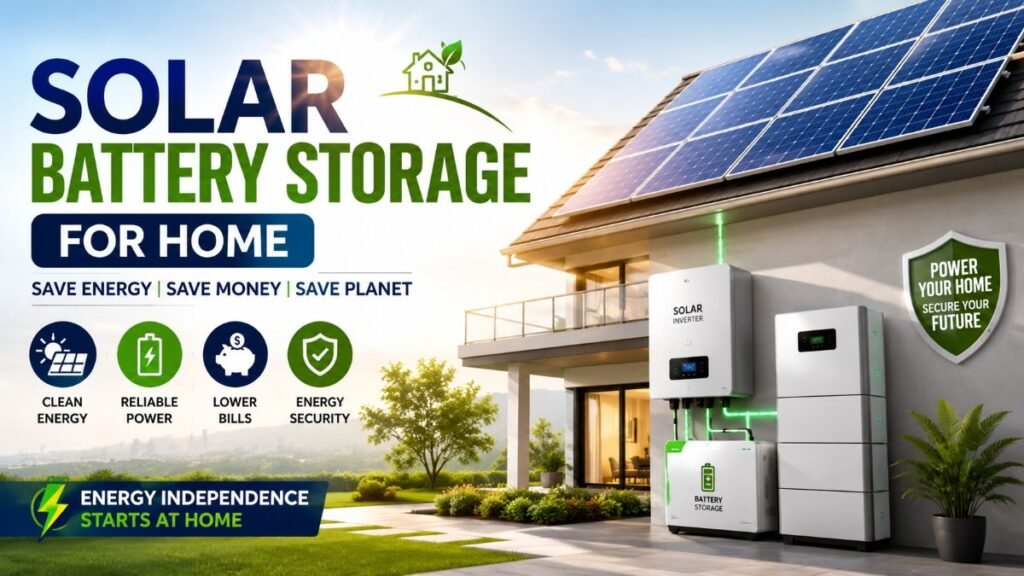
What happens when the grid goes dark or the sun sets on your rooftop panels? Most homeowners assume their solar setup has them covered—until they realize excess power vanished back to the grid. Installing solar battery storage for home fixes this, but buying the biggest battery on the market is a costly mistake. Real reliability comes down to usable capacity, continuous power output, and smart circuit management. Here is what actually matters before signing a contract.
What Is a Home Solar Battery?
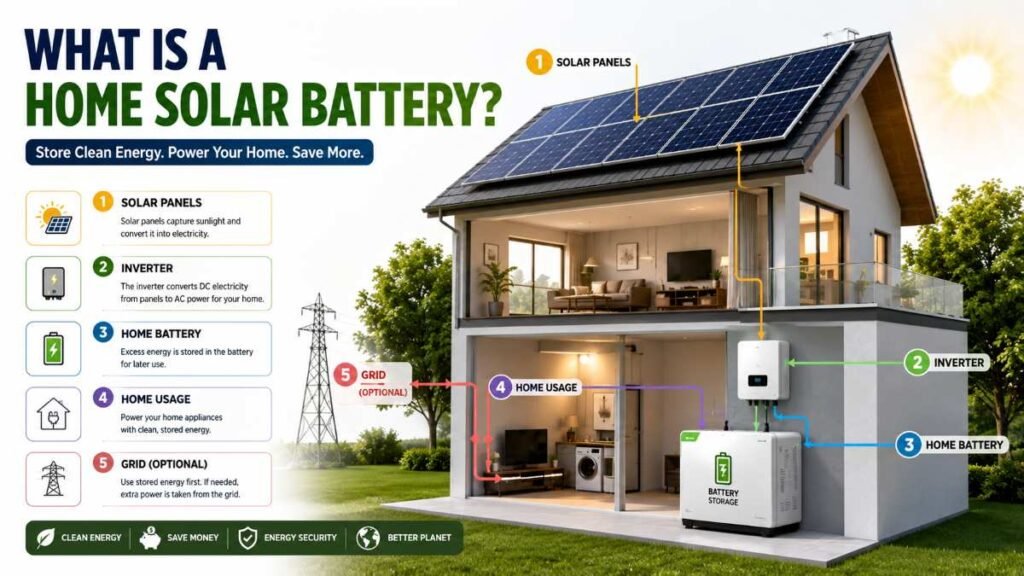
Think of a home solar battery as your household’s personal power bank. Whenever your rooftop solar array generates more electricity than your home needs in real time, the extra energy gets routed straight into storage instead of being sent right back to the power grid.
The energy flow works in a simple four-step loop:
Sunlight Capture → Immediate Home Use → Excess Charge to Storage → Evening Power Draw
Depending on your local utility’s setup, modern systems can also interact intelligently with the power grid—charging up when grid rates are lowest and powering your home when grid electricity prices surge.
Understanding Capacity vs. Power: kWh vs. kW
To avoid buying the wrong system, you must distinguish between total energy volume and instantaneous power delivery:
- kWh (Kilowatt-Hours) = Energy Volume: This measures the total quantity of electricity waiting in the tank. It dictates how many total hours your stored energy will keep the lights on.
- kW (Kilowatts) = Power Output: This measures the speed or strength at which energy can be discharged at any single second. It determines how many heavy-draw appliances you can run at the exact same time.
A high kWh rating alone won’t keep your air conditioner and electric oven running together if the system lacks sufficient continuous kW discharge power.
Why Are U.S. Homeowners Adding Battery Storage?
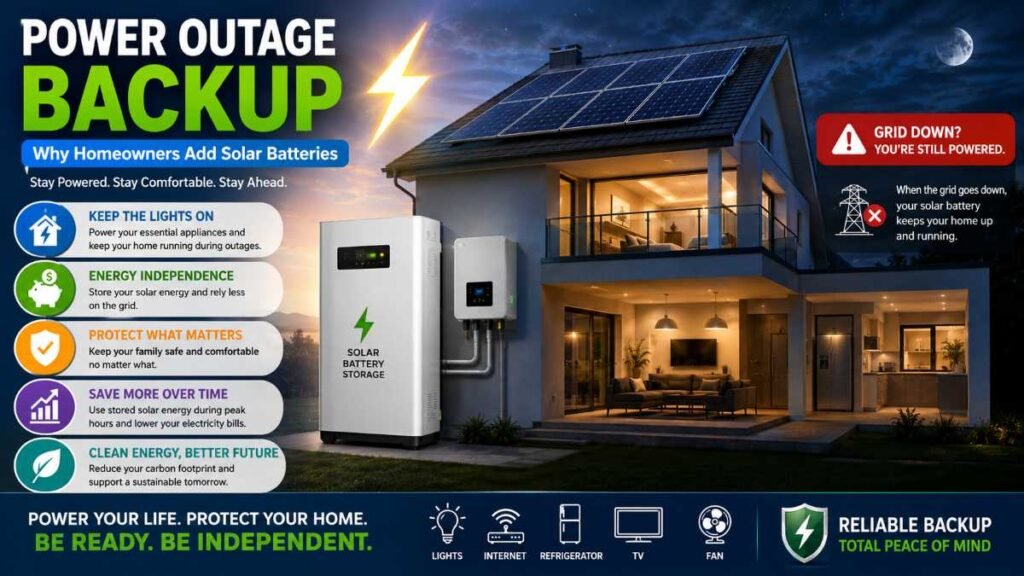
The primary appeal of solar battery storage for home is energy control and resilience. Storage shifts abundant daytime electricity to the evening when household demand peaks.
- Better Use of Solar Energy: Instead of exporting all excess generation, homeowners store it for later consumption. Real savings depend on local utility tariffs rather than generic online calculators.
- Backup During Power Outages: A properly configured system prioritizes essential circuits like refrigeration, lighting, internet, and garage doors. High-demand loads—such as central air conditioners or electric water heaters—drain stored energy rapidly. The U.S. Department of Energy (DOE) notes that solar-plus-storage improves resilience during outages when properly configured.
Time-of-Use Rates: In areas with variable electricity pricing, stored energy can offset consumption during expensive peak hours.
How to Calculate the Right Solar Battery Size for Your Home
Start with the job the battery needs to perform:
Goal | What to Evaluate | Main Planning Factor |
Evening solar use | Daytime surplus and evening demand | Daily energy use |
Essential backup | Critical household circuits | kW and kWh |
Longer outages | Essential loads and expected duration | Usable capacity |
Whole-home backup | HVAC and major appliances | Higher power capability |
Time-of-use savings | Peak and off-peak rates | Potential bill reduction |
For example, if essential loads average 0.8 kW and a battery provides 10 kWh of usable capacity, theoretical runtime is roughly 12.5 hours (). Actual runtime varies due to conversion losses, reserve thresholds, and fluctuating loads. Square footage alone is a poor sizing metric; consumption patterns and prioritized circuits tell the true story.
What Should You Compare Besides Battery Size?
Look closely at these primary variables:
- Usable capacity vs. Power output
- Backup configuration & Circuit coverage
- Round-trip efficiency & Warranty conditions
- System monitoring & Future expansion options
Note on Surge Protection: A battery system does not replace whole-house surge protection. Ask your electrician whether additional surge protection is appropriate for your home’s electrical system, or explore our whole-house surge protector guide to learn more.
What Does Home Battery Storage Cost?
Total installed costs depend on six key components:
- Battery Hardware & Enclosure
- Inverter / Power Conversion System (PCS)
- Backup Equipment & Critical Load Sub-panel
- Electrical Panel Work & Wiring Upgrades
- Permitting & Utility Interconnection Fees
- Professional Labor & Installation
Always request an itemized proposal:
Quote Item | Question to Ask |
Battery & Power | What is the usable capacity (kWh) and continuous output (kW)? |
Backup Scope & Electrical Panel | Which specific home circuits stay powered during a blackout, and are main breaker panel upgrades covered in this quote? |
Permits & Warranty | Who manages permitting, and what conditions apply to warranty coverage? |
Total Price | What is the complete installed price including labor and monitoring? |
Adding a Battery to an Existing Solar System
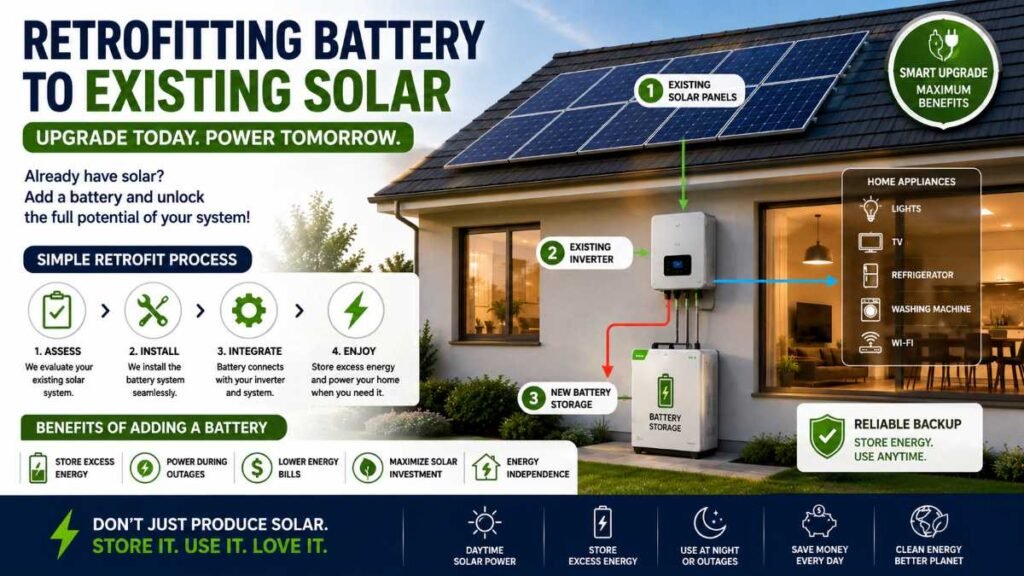
Adding storage to existing solar panels requires checking inverter compatibility, main panel capacity, and wiring architecture.
Before paying to store energy, reduce unnecessary consumption. Pairing storage with energy-efficient windows lowers HVAC loads, while upgrading to a heat pump water heater slashes peak water heating demand. Integrating battery controls with wider home automation—such as smart home installation principles or best smart thermostats—further streamlines management.
Installation, Safety and Location
Installing solar battery storage for home involves specific electrical, structural, and fire safety protocols. Utility coordination and permitting may be required depending on your location and system design. System placement must respect local building codes, temperature thresholds, wall clearances, and maintenance access.
Before signing a contract, verify where equipment will be installed, how the system behaves during an outage, and what happens when reserves reach baseline limits.
What About the Federal Tax Credit in 2026?
For homeowners, the federal Residential Clean Energy Credit is not available for qualifying property placed in service after December 31, 2025. Official guidance from the Internal Revenue Service (IRS) confirms that the 30% credit applied to qualifying residential installations through December 31, 2025, but does not extend to systems placed in service after that date.
State, local, or utility incentives may still exist in specific regions, but eligibility must be verified directly through current IRS guidance and local utility programs.
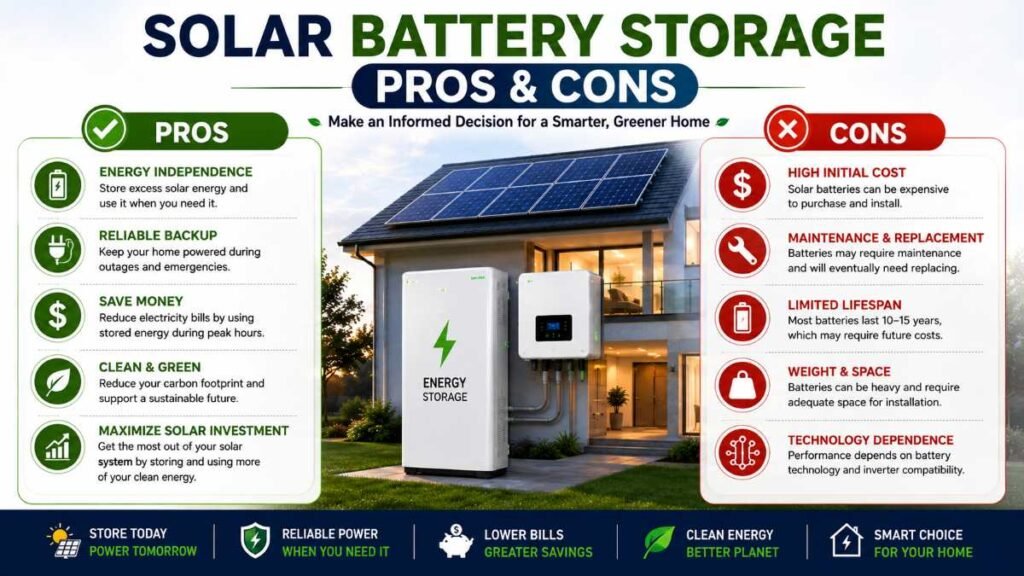
Pros and Cons of Home Battery Storage
Pros
- Direct energy control and improved power outage resilience
- Maximizes self-consumption of generated solar energy
- Optimizes usage under time-of-use (TOU) utility rate structures
Cons
- Significant upfront capital investment
- Finite operating life, with warranty terms varying by manufacturer and model
- Potential main electrical panel upgrade requirements
Is Solar Battery Storage Worth It?
Investing in solar battery storage for home is most compelling where grid reliability is poor, peak electricity rates are high, or outage protection is essential. The economic argument is weaker if installation costs are excessive or if utility net-metering policies remain highly favorable without storage.
Evaluate your last 12 months of electricity bills, peak solar generation, required backup loads, total installed costs, and local incentive availability before committing.
A Practical Buying Checklist
Work through this checklist before approving any installation:
- [ ] Define Primary Goal: Am I targeting outage backup, bill savings, or solar self-consumption?
- [ ] Identify Critical Loads: Which specific appliances must remain powered during a grid failure?
- [ ] Evaluate Specs: What is the battery’s usable capacity (kWh) and continuous/surge power output (kW)?
- [ ] Review Panel & Wiring Needs: Are main panel upgrades or sub-panels required?
- [ ] Inspect Warranty Conditions: What capacity-retention guarantee does the manufacturer provide, and what conditions apply?
- [ ] Check Expansion Limits: Can additional storage modules be added in the future?
- [ ] Compare Proposals: Have I compared multiple fully itemized installation quotes?
Final Recommendation
Solar battery storage for home adds flexibility and resilience when aligned with your actual energy usage. Start with your power bills, clarify your backup expectations, and evaluate proposals using usable capacity, output power, warranty coverage, and total installed costs.

Frequently Asked Questions (PAA)
FAQ 1: Is battery storage worth it with solar?
Yes, especially for outage protection or peak electricity savings. Adding solar battery storage for home maximizes energy independence, though full net-metering areas may see longer financial paybacks.
FAQ 2: How big of a solar battery do I need for my house?
Most U.S. homes need 10–15 kWh usable capacity. Size your solar battery storage for home based on required continuous power draw (kW) rather than square footage.
FAQ 3: What is the cost of a solar battery for a home?
Total pricing for solar battery storage for home includes battery hardware, inverter equipment, electrical panel work, permits, and professional installation labor.
FAQ 4: What is the best battery storage for solar?
Choose Lithium Iron Phosphate (LFP) systems with high round-trip efficiency and strong warranty terms. Match technical specifications to your home’s actual load requirements.
Author By: Dambar C. Rajbanshi About: A renovation strategist and home improvement enthusiast. Dambar specializes in budget-smart planning and functional kitchen design. He is dedicated to helping homeowners create spaces that perfectly balance beauty and practicality