
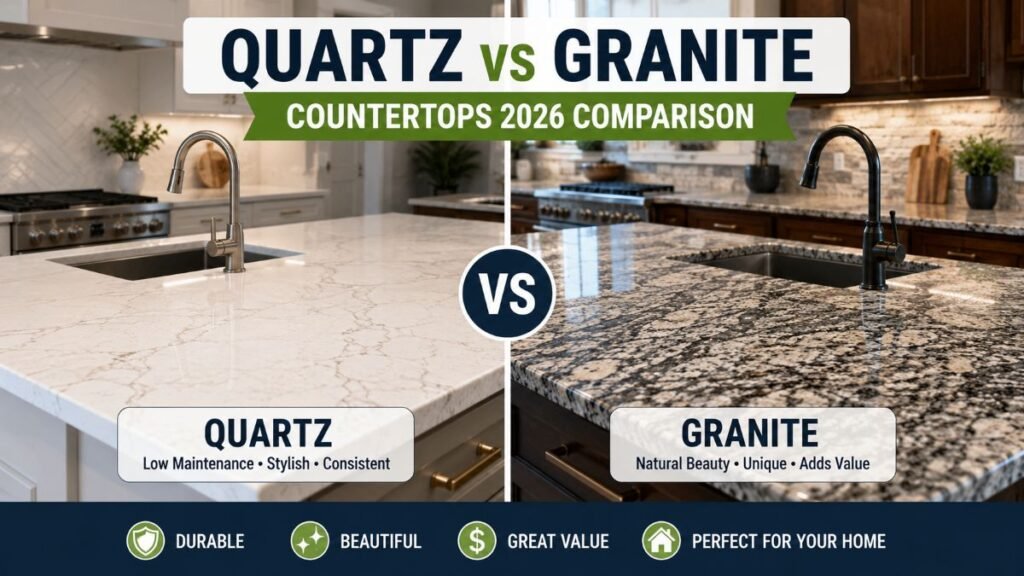
Choosing a kitchen countertop seems simple in a showroom, but daily cooking quickly exposes the real differences. Heat, stains, scratches, and maintenance instantly change the game. That is where comparing Quartz vs Granite Countertops becomes essential. One offers an engineered, low-maintenance surface, while the other brings one-of-a-kind natural stone character. So which material actually holds up best to your daily cooking, cleaning, and lifestyle habits? Let’s reveal the truth before you make an expensive mistake.
Quartz vs Granite: What’s the Real Difference?
The biggest difference is simple: granite is natural stone, while quartz countertops are engineered surfaces made with quartz minerals and other materials. Granite is quarried, cut, polished, and fabricated into slabs. Because its patterns come from natural geological processes, each slab can have its own colors, mineral movement, and variations.
Quartz offers more visual consistency. Because it is manufactured, you can select a pattern and color with greater predictability from one area of the kitchen to another.
Neither is automatically better. They simply suit different priorities.
Feature | Quartz | Granite |
Material | Engineered surface | Natural stone |
Appearance | Consistent and controlled | Unique natural variation |
Stain Resistance | Excellent | Very good; varies by stone |
Sealing | Usually not required | May be beneficial for some slabs |
Heat Resistance | Good, but protect from hot cookware | Excellent, but extreme localized heat can still cause damage |
Scratch Resistance | High | Excellent |
Maintenance | Very low | Low, with possible periodic sealing |
Best For | Convenience and consistent design | Natural character and heat-heavy use |
Quartz remains a prominent choice in professional kitchen design research, while granite continues to be a well-established natural-stone option.
Before replacing your countertop, it is also worth checking these kitchen remodeling mistakes so the material decision fits your overall renovation plan.
Quartz Countertops: Pros, Cons, and Everyday Performance
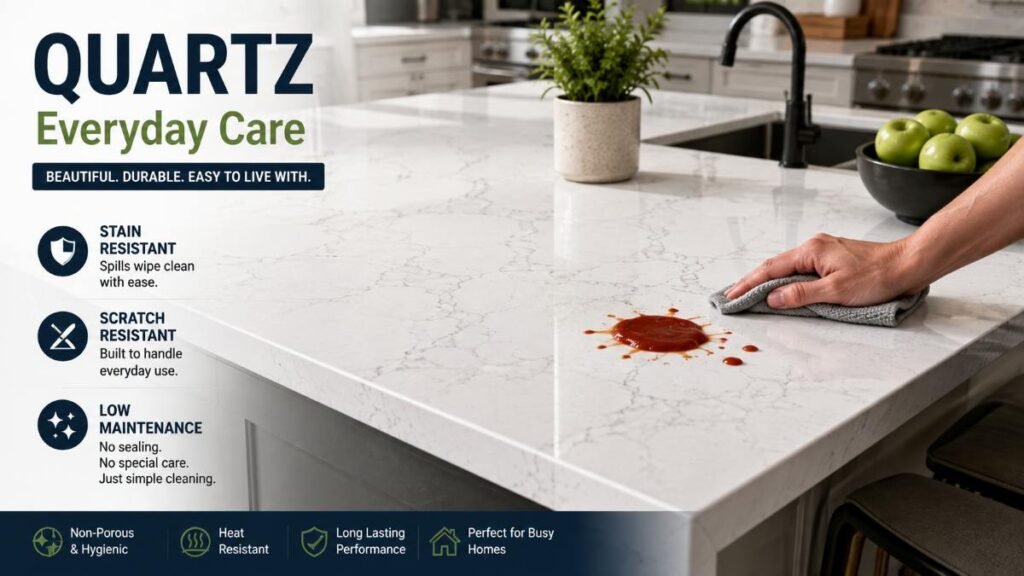
Quartz is often the practical choice for homeowners who want a countertop that is easy to live with. Its highly nonporous surface makes everyday cleanup simple. Coffee, cooking oil, sauces, and other common kitchen spills generally stay on the surface rather than soaking into the material.
Routine care is usually straightforward: warm water, mild soap, and a soft cloth are enough for many quartz products. However, care instructions vary by manufacturer, so always follow the instructions for the exact surface you purchase.
Why Quartz Is Popular
Quartz offers:
- Low routine maintenance
- Excellent everyday stain resistance
- Consistent colors and patterns
- Complements everything from rustic to contemporary aesthetics.
- No routine sealing for many products
It can also work especially well when you want a clean, coordinated kitchen design. That makes it easy to pair with freshly refinished cabinets or a new floor. For inspiration, see this guide on how to paint kitchen cabinets before choosing your final countertop color.
The Main Quartz Drawback: Heat
Quartz is durable, but it should not be treated like a permanent trivet. Manufacturers such as Caesarstone recommend using trivets or hot pads under very hot cookware because sudden or intense heat can damage the surface. Cutting directly on quartz is also not recommended because the surface is scratch resistant, not scratch-proof.
Best for: Busy kitchens where easy cleaning and low maintenance matter most.
Granite Countertops: Natural Beauty With Serious Durability
Granite appeals to homeowners who want their countertop to feel genuinely natural. Every slab has its own combination of mineral colors, texture, flecks, and movement. That means a granite island can become a major visual feature rather than simply another functional surface.
Granite is also exceptionally hard and durable. The Natural Stone Institute describes it as suitable for heavily used surfaces and notes its strong scratch resistance and high heat resistance.
Granite and Heat
This is one area where granite has a clear advantage.
Granite is typically highly heat resistant, but that does not mean extreme heat should be applied directly to the surface. The Natural Stone Institute notes that localized heat can create thermal gradients that may contribute to cracking.
A trivet is still a smart, inexpensive habit.
Does Granite Need Sealing?
Not necessarily.
The Natural Stone Institute states that most granite countertops do not need to be sealed, although many can benefit from additional stain resistance depending on the specific stone. The right approach is to ask your fabricator about the slab you are actually buying rather than assuming every granite countertop needs the same maintenance schedule.
Best for: Homeowners who love natural stone, unique patterns, durability, and strong heat performance.
Quartz vs Granite Countertops: Which Performs Better?
This is where the comparison becomes practical.
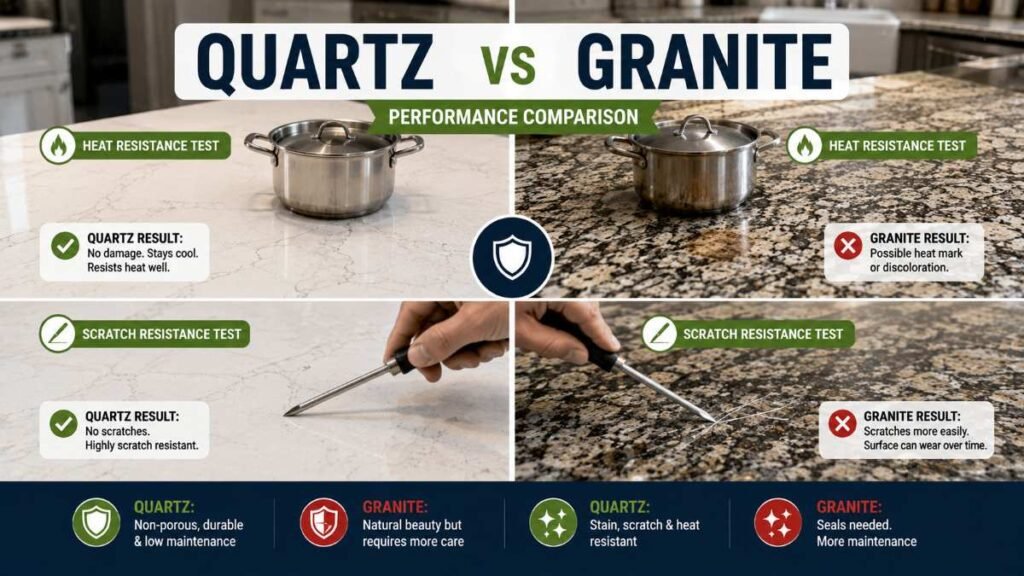
Heat: Granite Wins
If you regularly move hot cookware around the kitchen, granite has the advantage. Quartz requires more caution because high heat and rapid temperature changes can damage some engineered surfaces.
Winner: Granite
Stain Resistance: Quartz Wins for Convenience
Quartz is highly nonporous, which makes it particularly appealing when you want less worry about absorption and routine maintenance. Granite is naturally resistant to many everyday spills, but individual stones can behave differently.
Winner: Quartz
Scratches: Both Perform Well
Granite has excellent hardness and scratch resistance. Quartz is also highly resistant to everyday scratches, but neither material should replace a cutting board.
Winner: Very close
Maintenance: Quartz Wins
Quartz generally requires less ongoing attention because it does not usually need sealing. Granite is still relatively easy to maintain, but some slabs benefit from additional stain protection and stone-specific care.
Winner: Quartz
For a kitchen where cleanup is a daily battle, that difference can matter more than it sounds. Updating floor surfaces? Pair your choices with this kitchen flooring guide for a balanced design.
Which Countertop Is Better for Your Kitchen?
There is no universal winner in quartz vs granite countertops. Your kitchen habits should make the decision.
Choose Quartz If You Want:
- Easy everyday cleaning
- Minimal maintenance
- Consistent colors and patterns
- Strong stain resistance
- A predictable modern look
- A surface that suits a busy household
Quartz is particularly attractive for families who use the kitchen constantly and do not want countertop maintenance added to the weekly home-care list.
Choose Granite If You Want:
- Genuine natural stone
- One-of-a-kind slab patterns
- Strong heat performance
- Excellent durability
- A more organic or traditional appearance
- A statement island with natural movement
Granite is also worth considering when the countertop itself is intended to become one of the kitchen’s defining design features.
Cost, Installation, and What Actually Changes the Price
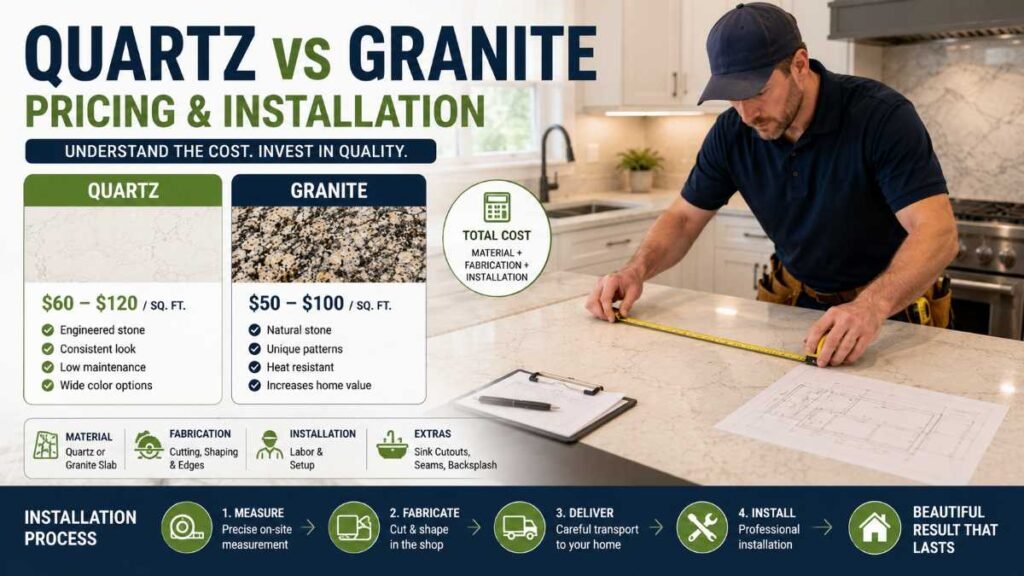
Comparing only the advertised price per square foot can be misleading.
Your installed cost may also depend on slab thickness, edge profiles, sink cutouts, cooktop openings, backsplash work, seams, island size, installation complexity, demolition, and local fabrication rates. A basic countertop with one sink is very different from a large island with several corners and waterfall sides.
That is why it is smarter to compare complete installed quotes rather than material prices alone. Also, confirm cabinet support before installation. A beautiful slab still needs the right structural support underneath it. For homeowners working with limited space, a carefully planned island can make a major difference. These small kitchen island ideas can help you think about countertop size and kitchen flow together.
Design: Natural Character or Controlled Style?
This decision mostly comes down to individual preference when choosing Quartz vs Granite Countertops. Quartz works well when you already have a specific visual goal. You can choose a clean white surface, subtle gray pattern, or marble-inspired design without the natural variation found in quarried stone.
Granite is different. Its natural variation is part of the appeal.
That is why you should inspect the actual granite slab before purchasing whenever possible, as advised by natural stone guidelines from the Natural Stone Institute. A small showroom sample may not show how the full surface will look. Pay attention to strong veins, color changes, and mineral patterns around the sink, island seating, and appliance cutouts. Manufacturers like Caesarstone note that proper layout planning ensures the final countertop looks intentional—not like an attractive part of the slab was accidentally removed during fabrication.
What About Granite Countertop Radiation?
Granite contains naturally occurring minerals, so it is possible for some granite to contain trace radioactive elements. However, when evaluating Quartz vs Granite Countertops, the U.S. Environmental Protection Agency says available evidence is insufficient to conclude that commonly used granite countertops significantly increase indoor radon levels. EPA identifies soil beneath homes as a much more common source of indoor radon.
The practical takeaway is simple: don’t panic over generalized claims about granite countertops. If you’re concerned about radon, testing the air in your home is the more useful step.
Common Countertop Buying Mistakes
One of the biggest mistakes is choosing a countertop based only on appearance.A second is selecting a slab from a tiny sample without considering how the complete surface will look.Another is ignoring installation details. Sink cutouts, seams, edges, island dimensions, and cabinet support can all affect both appearance and cost.
Finally, don’t assume quartz and granite have identical care requirements. Follow the manufacturer’s instructions for quartz and the supplier’s recommendations for your specific granite. For the rest of the kitchen, coordinated upgrades can also make the countertop feel more intentional. A new sink, for example, should be planned alongside the countertop layout; this kitchen sink installation guide can help.
Final Verdict: Quartz or Granite?
There is no single winner in quartz vs granite countertops.
Choose quartz when your priorities are easy maintenance, predictable styling, and everyday convenience. Choose granite when you want natural character, excellent durability, and stronger heat performance.
Before making the final decision, inspect the actual slab, compare installed quotes, confirm care requirements, and think about how you really use your kitchen. The best countertop is not necessarily the one that looks most impressive under showroom lights. It is the one that still feels like the right choice after years of everyday cooking, cleaning, and living.
Frequently Asked Questions
Q1: What is the best countertop material in 2026?
Answer: When comparing Quartz vs Granite Countertops, quartz wins for easy maintenance and stain resistance. However, natural granite leads if you need extreme heat tolerance.
Q2: Which countertop is better for an Indian kitchen, quartz or granite?
Answer: Evaluating Quartz vs Granite Countertops shows granite handles hot pressure cookers best, while quartz prevents turmeric and oil stains better. Use trivets, and quartz works great.
Q3: What are the trends for quartz countertops in 2026?
Answer: Current Quartz vs Granite Countertops trends feature warm tones, bold marble veining, matte finishes, and continuous stone backsplashes over plain glossy white.
Q4: Are granite countertops out of style in 2026?
Answer: No. Outdated speckled options are fading, but exotic slabs with dramatic veining remain high-end favorites in Quartz vs Granite Countertops selections.
Author By: Dambar C. Rajbanshi About: A renovation strategist and home improvement enthusiast. Dambar specializes in budget-smart planning and functional kitchen design. He is dedicated to helping homeowners create spaces that perfectly balance beauty and practicality